Touch here for mobile friendly version

Friday, December 30, 2011

Chevy Volt--Mechanical Engineer Perspective

Chevy Volt Plug-in Hybrid

1926 Model T tractor conversion


I took the above photos at the county fair this summer. The Volt and Model T tractor conversion are both the result of ever present engineering compromises that tend to be exacerbated when designing a multipurpose machine. With the Model T kit you could convert your car into a tractor for planting season. Although the idea of combining two machines into one was appealing, the kit was not very successful because the resulting tractor preformed poorly compared to real tractors.

With the Volt, you get an electric car and a gasoline car all in one. The electric car is inefficient because it has to lug around an inert gasoline engine, fuel tank, fuel pump, fuel injectors, radiator, oil filter, muffler, catalytic converter and other attending air pollution devices for when you run out of charge.

The gasoline hybrid mode for the Volt is inefficient because it has to lug around a large depleted battery and  two large electric motors in addition to the gasoline motor and its attendant hardware. This explains its dismal 33 mpg performance for a four-seat gasoline hybrid. The lack of a fifth seat is yet another compromise.


Another example of engineering compromise would be those pocket knives that combine just about anything you can imagine into one handy package. However, none of the tools contained in that knife work nearly as well as a separate tool designed for a specific use. Picture trying to measure something with that knife's ...measuring fish hook remover thingy. This explains why car mechanics and carpenters have thousands of dollars worth  of tools at their disposal instead of just one of these babies in their pocket.


Volt owners can also expect higher than average maintenance costs (lower than average reliability) thanks to the complexity of having two drive systems--an internal combustion engine driving an electric motor that in turn drives yet another electric motor.


Powered by electricity without being tethered to electrical outlets, the Volt does everything a great car does ...?

True to America's modern corporate culture, GM attempted to baffle consumers with BS rather than give them a product that earns its market share with superior engineering and performance (like the Prius and Leaf). To this day, journalists are still lumping the Volt in with electric car reviews instead of with other plug-in hybrids. GM's marketing machine had managed to convince the public that the Volt is an electric car. The latest commercials are an attempt to cool the hype because a small consumer backlash was growing ...not to mention Chevy needed a comeback for this Nissan Leaf commercial (look for the Chevy Volt in it). The gullibility of the American public isn't boundless after all.


Respectful comments are always appreciated. Click here to leave a comment(signed in members of Blogspot.com should use the comment link below this post).

Follow future and review past posts via Twitter

Click here--to see a list of articles and to subscribe to future posts or subscribe by email

Enter your email address:


Delivered by FeedBurner

Sunday, December 4, 2011

Animal Liberation and Climate Change

I recently concluded a comment field debate with a member of Animal Liberation of South Australia over at Brave New Climate. It's a good article and well worth a read. I made a few critiques in the comment field which blew up into a full scale debate. Go have a look if you've nothing better to do.

I don't disagree that livestock is doing tremendous damage to the biosphere and I wish more people would look for answers instead of continuing to rant about the problem. I suggested that his proposed solutions (taxation and education) were woefully inadequate. I also disagreed with some details in his argument. The truth is that eggs, dairy, and meat add variety to the diet of the third world poor who are at risk of nutritional deficiencies because their diet, although possibly adequate in calories, may not be be varied enough. Domesticated animals were humanities original multivitamin. In first world nations the excessive consumption of animal products has become a bit of a perversion.

He mentioned that about a third of all crops are not used for food but are instead fed to livestock. In reality, livestock is a means of processing crops into more varied forms of food. So it's misleading to claim that a third of crops don't go for food. Biofuels are the real danger there.

And to be honest, although we could and should consume a lot less egg, meat, and dairy, it isn't all that much per person when you think about it. The main problem is that there are 7 billion of us doing it. The few cups of brown tainted liquid called tea and coffee we consume every day is also wreaking havoc with ecosystems.

The backbone of his argument is the fact that people can get adequate protein without "meat" if they have enough variety in their diet, which is true for most people today, especially in first-world nations, but somewhat misleading because this argument rests on the assumption that all 7 billion of us have the needed variety and would be fine without "meat."

I pointed out that since meat, eggs, milk, cheese, whatever, are roughly equivalent when it comes to resource use, environmental impact, and green house gas emissions, that it's somewhat misleading to keep using the term "meat." I suggested he use a more accurate phrase. The term animal sourced food (ASF) is commonly used for this. He didn't bite. His second article sticks to meat.

I realized in the course of the debate that I was focusing too much on protein supplied by animal sourced foods and switched to terms involving nutrients in general.

The second installment in this series is now up and his argument has been honed, in part, thanks to our debate. In one of my comments I critiqued one of his sources, "A 124 page paper on child nutrition and not a single mention of protein?"

In his new post we find the sentence:

A 124 page paper called “Explaining child malnutrition in developing countries” by acknowledged experts (yes, from IFPRI), has not a single occurence of the word “protein”.

Not sure how relevant that is. Turns out, there are also no instances of the words vitamins, minerals, fats, or even nutrients in that PDF. Nutrition issues involve a lot more than just protein. Some more food for thought:

"...nutrition programs have shifted their primary emphasis from control of protein deficiency, to energy deficiency, and now to micronutrient deficiencies... ...1) the most important findings of the CRSP were that faltering in height and weight of children occurs early and was not caught up later in life; and 2) the quality of food (specifically ASF and micronutrient content) was a much stronger determinant of nutritional status than was the quantity of food. ...1) growth stunting started at birth (or before) and was complete by 18–24 mo; 2) protein intakes and protein quality were adequate in all three locations as were energy intakes except when a famine occurred in Kenya; and 3) ASF intake was the strongest predictor of functional capacity (such as growth, lactation outcome and cognitive function)..."
See http://jn.nutrition.org/content/133/11/3875S.full.pdf for full quotes in context.

Respectful comments are always appreciated. Right click here to leave a comment (signed in members of Blogspot.com should use the comment link below this post).

Photo courtesy of devlyn via Flickr

Follow future and review past posts via Twitter

Click here--to see a list of articles and to subscribe to future posts or subscribe by email

Enter your email address:


Delivered by FeedBurner

Saturday, October 8, 2011

Electrification Nation--Why Natural Gas Won't Save Our A**


Right click on the above figure to open it in a new window. Note the modified text on the left.

The DOE report of their first Quadrennial Technology Review strongly suggests, at least to me, that we must greatly increase electrification of transport, manufacturing, and even home heating, using the lowest carbon sources available, which would be nuclear and renewables. In other words, we must generate much more electricity and all of it must come from nuclear and renewables.


By replacing all coal in the United States with natural gas (more than doubling the amount of natural gas burned today) we would reduce our total GHG emissions a mere 15%. In comparison, if we replace coal and natural gas with 30% renewables (which is as far as wind and solar photovoltaic can scale because they are so intermittent) and 70% Gen III reactors of the small modular variety, we would reduce GHG emissions about 57%.

Once electricity generation has been decoupled from GHG production, it can be used to power compressors to turn natural gas into liquefied natural gas (LNG) without incurring an additional carbon penalty associated with LNG today that uses coal or natural gas sourced electricity to compress the gas. This lower carbon LNG can in turn be used to replace petroleum in many applications. By replacing petroleum for transport with a combination of plug-in hybrids, electric vehicles, LNG vehicles, we would be approaching the needed 80% reduction in GHG releases. Some petroleum could still be used for things like aircraft where there simply is no other less environmentally destructive alternative fuel to be used.

What is a Gen III reactor? From Wikipedia:

A generation III reactor is a development of any of the generation II nuclear reactor designs incorporating evolutionary improvements in design developed during the lifetime of the generation II reactor designs. These include improved fuel technology, superior thermal efficiency, passive safety systems and standardized design for reduced maintenance and capital costs.


What is a passive safety system? From Wikipedia:

The mPower is designed so as to make loss of coolant accidents impossible due to the Integral Reactor Vessel which contains the entire primary coolant loop within the reactor pressure vessel. If secondary cooling is lost, creating an effective loss of standard heat removal, there are water supplies located above and within the containment that can be used to cool the IRV with gravity driven-cooling. Further advanced means of heat removal can be used in the event that these systems are exhausted, such as by flooding the containment and establishing natural circulation.


What is a small modular reactor? From the DOE report:


And from Wikipedia:

Small modular reactors (SMRs) are part of a new generation of nuclear power plants being designed all over the world. The objective of these SMRs is to provide a flexible, cost-effective energy alternative.

Small reactors are defined by the International Atomic Energy Agency as those with an electricity output of less than 300 MWe, although general opinion is that anything with an output of less than 500 MWe counts as a small reactor.

Modular reactors are manufactured at a plant and brought to the site fully constructed. They allow for less on-site construction, increased containment efficiency, and heightened nuclear materials security.

Large nuclear power plants are generally rather inflexible in their power generation capabilities. SMRs have to have a load-following design so that when electricity demands are low they will produce a lower amount of electricity.


Why small modular reactors? Again from the DOE report:

The policy and market risks make it easier to finance assets with low capital and uncertain operating expenses (e.g., natural gas generators) than those with high capital and low operating expenses (e.g., renewable and nuclear power plants).

Because planning, regulatory, physical, security, and capital risks increase with scale, investors and policy makers have preferred modular deployment of new technologies at the scale of a few hundred megawatts, ... Smaller-scale technologies also enable consumer deployment of generating technologies—a trend in the residential,commercial, and industrial sectors. Generators closer to the load also provide more reliable service and lower transmission costs, although there can be local resistance to new deployment. generating capacity distributed over many locations can also increase reliability and energy security.

Translation: SMRs are a lot cheaper than conventional nuclear plants. The market is hesitant to spend so much up front on large conventional nuclear power just as I am hesitant to spend $60 grand on solar panels although I know they will pay for themselves over time.

And some more on this subject from the DOE:

As other technologies mature and attempt to enter the electricity market, easy integration into the established system is a competitive advantage. Generators that run on fuel [natural gas and small modular nuclear] can be sited more flexibly than those that directly capture a diffuse, renewable resource. In particular, they can be located near load centers and existing transmission infrastructure, lowering barriers to deployment.

...of 442 civilian nuclear power reactors and an additional 65 reactors currently in some stage of construction, civilian nuclear energy sits at the nexus of energy, climate, and security.


Let me take a moment here to point out some problems. If the United States were to accomplish the above, we would have a glut of oil and natural gas. Just as we export coal and corn ethanol today, and import Canadian tar sand oil, we would likely export our oil, coal, and natural gas. There would be a lot of money made but no progress on global warming if countries like China burn all that we do not.

The asinine idea that our military should go green and use biofuels to kill people would also go away because they would have all the oil they need to fight any just or unjust wars with.

Following are some more charts (modified by me) from the report.


Most of the rest of our emissions essentially come from liquid fuel for transport--petroleum. So ...what options does the DOE think we have for liquid fuel for transport?


According to the report, after two decades of government subsidies and five years of mandated use, ethanol replaces only 7% of gasoline, usurps 40% of our corn crop and would require the most massive build out of infrastructure (fuel pumps, pipe lines, tanker trucks/trains), of all transport energy options. Oh, and it exacerbates increasing food prices and land use change around the world, does not reduce the impacts of price or price volatility on the consumer ...and as you can see above, does next to nothing (if anything) to reduce GHG emissions (because most of the energy in a gallon of ethanol comes from natural gas).

According to the report, for mass transit (urban buses, passenger trains) and light duty transport (cars and small trucks), our best option is electrification and efficiency--not replacing petroleum with biofuels. You certainly don't want to use natural gas to make electricity for transport because you would generate about the same amount of GHG as burning petroleum because about 40% of the energy in the natural gas is lost at the generator and power lines and another 30% from the electric motor inefficiency.

We really don't have any non-petroleum options for airline travel. And although this DOE report claims we don't have any options for long haul vehicles like semi-tractor rigs and ships, I don't see why truck stops could not provide natural gas and the rigs could certainly carry very large tanks. I also don't see why ships can't run on natural gas as well because they certainly can carry tanks of methane big enough to get across an ocean.

Follow future and review past posts via Twitter

Click here--to see a list of articles and to subscribe to future posts or subscribe by email

Enter your email address:

Delivered by FeedBurner

Sunday, October 2, 2011

Accusations of "another Solyndra"


Photo courtesy of Major Clanger via Flickr

Dumb headline, I know. I borrowed it from an article discussing a Mill Valley town council decision "not" to put in more electric car charging stations.

A local resident stood up to call electric cars something that was being forced on the community by the Federal government, "another Solyndra" that just "plain doesn't work."

Whatever. The cost of putting them in is relatively small (as will be the cost of tearing them out again when it's realized they are unnecessary). I suspect the real concern is lost parking space.

As the owner of a Leaf (and an electric bike) I tend to agree that the government should not be installing chargers. They are for the most part a waste of money. It's a bit foolish to rely on a charger being available at your destination if you need it to get home again. You may find your spot taken by another vehicle, or the charger may be out of service. And if you don't need it to get home again ...you don't need it.

What are the odds? Pretty high from my experience. I know one guy who was counting on a Nissan Dealership who didn't come through. I know another guy who found the plug filled with mud and rocks (vandalism) and a woman who found the outlet she was counting on to get home was just plain dead, probably from a thrown breaker.

I've had no need for a public charger primarily because I don't intend to ever need one. I've used our other car twice in the two months I've owned the Leaf. Electric cars should not be used out of their designed range and are best suited for urban two-car families. They are not for dummies.

Let the market decide if and where to put chargers. My local Fred Meyers store put a charger in. I've never used it but I know a person who has. She certainly does not need to plug in to get home so I asked why she bothers. When I pointed out that she is only getting a few cents of free electricity and less than a mile or so of extra range she replied, "Every little bit helps." In other words, she does it because it feels good and you know what they say, "If it feels good ..."

Fred Meyers and a lot of other businesses will find out if the chargers increase profit margins because it feels good to enough electric car owners ...or not.

There are many things that government is best at. Some things just can't be left to the market. In general, the government should not attempt to do anything that the market can do better. I suspect that the installation of car charging stations is one of those things. Read Governors of West Coast States Nominated for Nobel Prize.


Click here--to see a list of articles and to subscribe to future posts or subscribe by email:

Enter your email address:

Delivered by FeedBurner

Wednesday, August 24, 2011

Electric Bicycles Unite!


Click here to read about a rally sponsored by the Northwest Electric Bicycle Network last year (read the full blog here).


Although the Northwest Electric Bicycle Network is not officially organizing an event this year, electric bike riders will be congregating at 10:00 AM, Saturday, September 24th at the gate entrance to Golden Gardens Park in Seattle in support of the Moving Planet event. You are free to join in. It is suggested that riders form into groups of five or six, spaced out at five minute intervals to avoid causing traffic congestion at intersections and along the trail. The trail speed limit of 15 mph should be strictly adhered to.

Each rider is of course on their own recognizance and will be responsible for their own safety if they choose to ride to Gas Works park. A group of regular bike riders will also be heading to Gas Works from Wallingford Park to rendezvous with electric bike riders. They will be heading from there to the South end of Lake Union to join the festivities and you are welcome to join them on that ride as well.


(click on the above image for a larger view)

Click here to view high resolution photo.

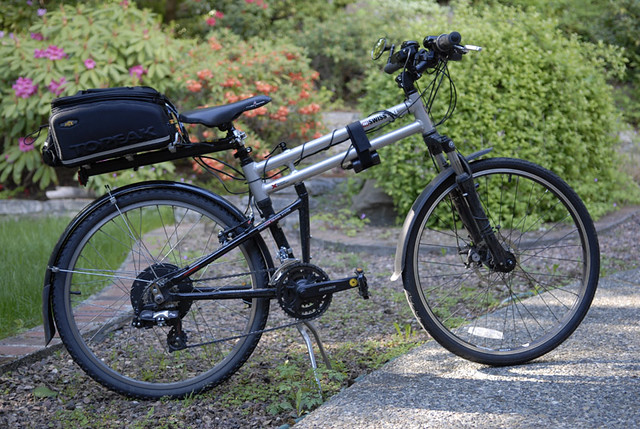
Also ...pictured above is the latest incarnation of my electric bike (just finished it last week). My controller recently blew after almost five years of reliable service. It took out three of the four BMS circuit boards in my Dewalt battery packs as well.

This seemed like a good time to upgrade my components. Go here to see a video of the original Ultimate Hybrid Electric Bicycle.

I was using the old Crystalyte 408 motor and the bearings were starting to go out. I also wanted to upgrade to the latest CycleAnalyst power monitoring system so I could limit current draw by my motor and eliminate the magnet-based speedometer. I purchased my new components from Ebikes SF and everything works as advertised.

Crystalyte has a new motor design that is bigger in diameter but thinner than the 400 series motors. It has more power for about the same weight and can accept a rear brake disk.

They offer a version of the motor and controller that does not use halls sensors. Halls sensors are tiny little devices in the motor that send signals to the controller that allow it to send power back to the motor even when it is not spinning.

Without halls sensors, the motor must start spinning before the controller will send power to it. This is called a sensorless motor/controller configuration. The advantage of not having halls sensors is that you are not prone to overcurrent your controller when starting up from a dead stop. You also have a simpler system that is less likely to fail because of a problem with a sensor.

This new motor starts so fast and smooth with just a small amount of rotation that I can hardly tell the difference from my old version with sensors and it has quite a bit more power as well.

Starting from a dead stop going up a steep hill will be problematic ...but that's always true and that is also how I blew my old controller.


Ray Brown (co-founder of the Northwest Electric Bicycle Network) recently replaced his geared hub motor (bike pictured above), also purchased at Ebikes SF.

Click here--to see a list of articles and to subscribe to future posts or subscribe by email:

Enter your email address:

Delivered by FeedBurner