Touch here for mobile friendly version

Saturday, June 23, 2012

First Vehicle to Home Power System in North America

Cross-posted from Consumer Energy Report

Nissan issued a press release earlier this month to announce that Power Stream will be using the V2H system with its fleet of Leafs in Canada. This device acts as a charger and as a power inverter, allowing 4 hour charges instead of 8 hours as well as the capacity to power a home for a couple of days in the event of a power outage. Apparently your Leaf has to have the CHAdeMO protocol quick charge port which was an option on the 2012 cars.

The price seems about right to me costing roughly twice as much as the charge stations now installed in homes but that’s still cheaper than a charge station and a backup generator system. And if you live where there is a significant price difference for night electricity use it can defer some of its cost as well.
From the press release:
  • The EV communicates directly with the utility or with the home energy manager to help manage electricity consumption;
  • The EV acts as a back-up power source in the event of a power outage;
  • Time-of-Use demand response scenarios where devices in the home like the refrigerator, washer/dryer and EV charger react to changes in the prices of electricity based upon the time of day.
Click here to see a video presentation.

I’ve got this on my wish list when they become available in the States. Combine this with solar panels to keep the car charged and you could weather a power outage for as long as you can get enough sunshine. I could also see these units being sold at car dealerships. Instead of opting for leather seats, you might opt for a home power system.


 Something else I have on my wish list.


Friday, June 8, 2012

Will Fukushima Save the Bluefin Tuna?


Cross-posted from Consumer Energy Report

From a story well worth reading in Forbes titled Fukushima Radiation May Actually Save Bluefin Tuna:
If the governments can’t help, maybe bad publicity will [save the bluefin tuna]. Nicholas Fisher, the study’s co-author and a marine biologist at Stony Brook University in New York, says when he first saw the levels of radiation in the fish, caught off of San Diego, “my first thought was ‘this will do more for the conservation of this endangered animal than nearly anything else could.’”
Which is also the first thing I thought when this story first broke. And yes, I know that isn't a picture of a bluefin tuna. On the other hand, the Pacific blue fin is not the subspecies in trouble. It is the Atlantic version. Beware the laws of unintended consequences. When one species collapses we tend to increase pressure on what remains. If the public won't eat Pacific tuna, the pressure on Atlantic tuna may just get worse. From Wikipedia:


Global appetites for fish, especially Japanese appetite for sushi, is the predominant threat to Atlantic bluefin.

On the other hand, the public doesn't know one tuna variety from another, and few are going to bother memorizing which is which. If they get the mistaken impression that tuna has unsafe levels of radiation in it, to play it safe, they may chose to not eat tuna, regardless of type.One can only hope.

There are natural levels of radioactivity in the tuna, and Fukushima has only added the slightest amount more. (The report can be found here.) “But people are often anxious about radioactivity,” says Fisher. And this may be what ultimately benefits the Bluefin. The fish, Madigan points out, is not harmed by the radiation that they collected while swimming through the spill waters off the coast of Japan after the tsunami.
I listened to a story called "Radioactive tuna!" on NPR a few days ago. They had interviewed the head of a research team that identified Fukushima as the source of ceisum-134 and cesium-137 in Tuna caught off the coast of California. To be fair, they also mentioned that you would have to eat thousands of pounds of this tuna in one year to exceed a safe dose. They also mentioned that pregnant women have been warned for decades not to eat tuna because it contains elevated levels of mercury. Not mentioned was the source of much of that mercury--coal-fired power plants.

The researcher said that he'd been getting a phone call (including one from Al Jazeera) about every thirty seconds or so from media outlets looking for a story.

The NPR story elicited a very short retort titled Nuclear Tuna and Media Trivialization by a relatively high profile anti-nuclear activist. It's only a few hundred words long, conflates nuclear energy with nuclear weapons, contains numerous out of context quotes, and is devoid of a single source (not worth a read if you're considering it).

Radiation stories attract readership. I suspect that we're attracted to stories about danger and mayhem because at some level of consciousness, we are looking for information that may help protect ourselves and our loved ones from potential harm. This proclivity has no doubt served our species well for millennia, but in today's hopelessly complex technological world we are barraged with this kind of information and are often unable to sift the wheat from the chaff.

On the other hand, just last week a man went on a shooting spree and killed several innocent people a few blocks from my home, one of which was the mother of one of my daughters' classmates. Two years ago a man was murdered with an ax on the street one block from where my daughter was sitting in a classroom. Several years ago a bus driver was shot dead causing the bus to careen off a bridge, landing on the street I live on, just three blocks away. I could see why someone might develop a fear of going outside, sometimes called agoraphobia, but to get a case of radiophobia, you would need a lot of help from the media.

A lot of Americans have an excessive fear of flying, bugs, snakes, radiation, you name it, anyone one of which can kill you but the odds of any of them killing you are vanishingly low. How is it that we come to fear some things more than others? Fear is easily teachable. Parents can pass on a fear to their children, or not. My children have no fear of snakes, although they certainly know better than to handle a venomous one. I know people who are terrified of insects. My daughters love insects.


I suspect that the excessive fear of radiation started with nuclear weapons and was parlayed into a fear of nuclear energy by association thanks to anti-nuclear activists, some of which are likely motivated by personal phobias (an excessive, irrational fear).

Before the nuclear test ban treaty the United States alone detonated over 330 nuclear weapons (submerged in the ocean, buried underground, shot from canons, launched into space, you name it). The realization that all of the nuclear powers were repeatedly releasing all of that radiation into the environment is sobering but at the same time it puts into perspective just how out of perspective the public’s concerns are over radiation from nuclear power plants.

We've all read about the effects of massive doses of radiation on the victims of nuclear weapons on Japanese citizens. I recall reading the book Hiroshima by John Hersey when I was in grade school. After being told that the gods would favor anyone who made a thousand origami cranes, a little girl (just my age at the time of the reading) who was dying of leukemia made 600 of them before succumbing.

People have been taught to fear it by decades of post-apocalyptic science fiction (books and movies). My favorite (among many) post-apocalyptic sci-fi stories is A Canticle for Lebowitz. Anyone remember the movie On the Beach (1959 or 2000 versions)?

Note at this point that we're talking about radiation effects from nuclear weapons and other than Hiroshima and Nagasaki, it's all fiction. Anti-nuclear activists learned early on the effectiveness of conflating nuclear weapons with nuclear energy. That's why just about every anti-nuclear article you read will mention nuclear weapons.

But then Chernobyl happened. The amount of concentrated radiation released by that accident dwarfed that released by a nuclear bomb, yet in the end it created Europe's largest nature preserve. Wildlife in the exclusion zone is thriving quite simply because the radiation is keeping people away.

I thought what biologists learned from Chernobyl was going to be the death knell for stories about mutants. However, the latest mutant horror flick, Chernobyl Diaries, has just been released.

It has been proposed by some (but not by me) that we could use this fear to keep humanity out of critical ecosystems by sewing them with low levels of radiation and posting warning signs around their periphery. Not a good idea. Profit motive will trump fear in this case and poor workers will be the ones used to exploit these areas, radiation or no radiation.

There are many carcinogens in our environment that can increase the incidence of cancers, including many viruses. Click here and scroll down to see the very extensive list.

When the quake hit Japan there was a virtual eruption of carcinogens into their environment from fires, exploding chemical plants, failed dams, polluted ocean sediments heaved up on the land, radiation from the stricken power plant, and on and on. Fukushima was just one of the thousands of sources. There may very well be a modest uptick in cancer rates from this quake from the many sources of carcinogens, but the latest research suggests that the contribution from Fukushima alone will be too small to detect.

Tuesday, May 22, 2012

Plug-in Solar Panels

Cross-posted from Renewable Energy Report

An article over on CNET titled Got a deck? Solar panels now a plug-in appliance, suggests that you can buy from Amazon.com a 1,000 watt solar panel system that plugs into your wall outlet for only $1,099. I thought they were really on to something until I read the comments:

This article was written very poorly. At first read, it would appear that the 1,000 watt system costs $1,099.95, but going over to Amazon, that is just the price of one panel whose rating is 240 watts.
 
At about $4.58/watt, these panels will not produce electricity to pay for the finance charges alone. You will not be able to recover your investment on this, as the panels deteriorate through time.
If the 1,000 watt system costs $1,099.95, it would truly be disruptive as it will be feasible. But no, this solar PV will not cut it, still too expensive. If they can just sell these to about $2/watt, then it would be very worthwhile, given that you will mount these yourself.

On the other hand, I think this concept has potential (no pun intended). I bought a cheap solar inverter last year similar to the one in the above article just to experiment with. You connect one end to a solar panel and plug the other end into a wall outlet. The device converts your solar panel’s low voltage direct current into high voltage alternating current. Because the voltage (electric potential) from the inverter creates an electric version of back pressure against the voltage from the power company, it will reduce the amount of power coming into your house from the power line, which will slow down your electric meter, reducing your electric bill.

Modern homes tend to have significant phantom loads (appliances that draw a small amount of current even when you turn them off or when not in use): computers on standby, DVRs, televisions, motion sensors, the clock in your microwave and stove, tuners, routers, furnace, thermostat, chargers, and on and on.
Not many people have a thousand watts of phantom load so purchasing a thousand watt system would be a waste unless you plan to run things like the dishwasher, and clothes dryer etc. in sequence the whole time the sun is shining.

These inverters are intended to supplement your house power grid, not to spin your electric meter backwards. They will not send power (Volts times Amps) to your house wiring if there is no voltage coming to your house from the power company. This is to protect electricians who may be working on wiring inside or outside your house when the power is off. They of course, also won’t reduce phantom loads when the sun isn’t shining.

 
The inverter I purchased off Amazon cost about $100. It isn’t UL listed so I wouldn’t want to place it anywhere that might start a fire if it blew up. The one mentioned in the above article is, in theory, UL listed. I was testing one out just last week in my drive way. I had it plugged into a Kill-A-Watt to see how much power it was supplying for a given solar panel angle. A neighbor walking by asked how much it was producing. When I said “About 35 watts,” he suggested it would never pay for itself, and he was right. But then again, when did granite counter tops ever pay for themselves, or produce any power for that matter? A system like this could be viewed as a high-end appliance to reduce phantom loads.

I’m not recommending that people run out and purchase these because they are of questionable quality at this stage of their development, and I’m also not sure of their legality. I can envision a day when systems like this that cost less than a $ 1,000 might be (as insulation and double pane windows already are) required by building codes in sunny climates to reduce the impact of the significant and growing phantom loads. And who knows, if the price gets low enough, builders and home owners may start installing them to show off to neighbors.

Saturday, May 19, 2012

How Much Are You Willing to Pay for Clean Energy?


 Cross-posted from Renewable Energy Report

A recent study published in the subscription only Nature Climate Change (which I do not have a subscription for) found the price Americans are willing to pay to have 80 percent "clean" energy by 2035. Drum roll please  ...$13 bucks a month.

The researchers went a step further and calculated that the cost would have to drop even further to overcome political barriers:
"The researchers — Joseph E. Aldy, Matthew J. Kotchen and Anthony A. Leiserowitz — ran a what-if exercise and found the current level of public support insufficient to overcome entrenched opposition in Congress.
Majority rule does not really apply there, of course: getting anything controversial through the Senate, for example, requires 60 votes to break filibusters. With some number-crunching and assumptions about how preferences back home would influence the votes of lawmakers, the researchers found that the annual added cost per household of a clean energy policy would have to drop below $59 a year to pass the current Senate and below $48 a year to pass the current House."

Ignore for a moment the fact that there is no consensus as to what constitutes a clean energy source. The survey also assumed that 80 percent "clean" energy was technologically and economically feasible, which is about as useful as asking people how much they would be willing to pay to vacation on Mars.

Their willingness to pay declined if nuclear or natural gas were included in the definition of "clean." Not having access to the full study, and judging by the name of the journal, I am assuming that by clean, they meant sources that produce the least amount of greenhouse gases:

 
Justin Gillis of the NYT interprets this to mean that ...

"If we are going to bother with it at all, the public seems to feel, we might as well go deep green."

Riiight  ...deep green, whatever that means. Almost all "deep green" energy today, depending on definition, comes from the combustion of plant material and the damming of river ecosystems. Scaling either one up will exacerbate the extinction crisis. Read Will mega-dams destroy the Amazon? Then read Wildlife in the tropics plummets by over 60 percent.

Over the last 20 years renewable energy in the U.S. has gone from 11% of our mix to 10%. From How wind power fits into our energy diet:

 
The Natural Resources Defense Council and the Sierra Club have recently joined forces to try to stop a solar project in California:

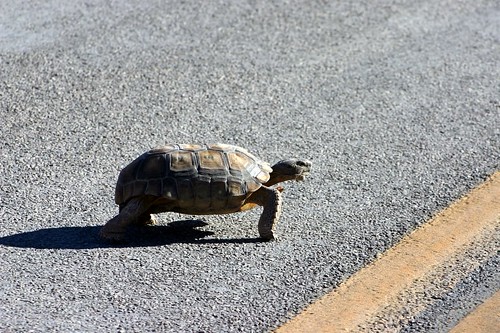
"...the Calico project covers 4,000 plus acres of important wildlife habitat in the Pisgah Valley, including key desert tortoise habitat.  Building this solar power plant would also threaten at least six other imperiled species such as burrowing owls, golden eagles, Mojave fringe-toed lizards, Nelson’s bighorn sheep and several rare plants."

Photo courtesy of j03via Flickr

Sunday, May 6, 2012

Electric Car News

Electric Ford Focus

This article originally appeared at Consumer Energy Report.

Some test drive reports for the electric Ford Focus are out--fake radiator grill, optional leather seats, looks like a regular car, blah, blah, blah. Other than superficial appearances, it's almost indistinguishable from a Leaf in performance, costs a few grand more. One was used as the pace car at the NASCAR Sprint Car Series race last week in Richmond so at least they are marketing the thing and the Leaf really could use some competition. Then again, I also thought the Prius would have met some stiff competition from American hybrids by now. The latest episode of the sitcom 30 Rock was about an American engineered couch that was so uncomfortable the government bought them to torture terrorists ...I think I have one of those couches.

If you are looking for another made-in-America electric car, this may fit your bill, although I honestly don't know how much of it is made in America. Nissan has a factory in Tennessee that will be able to produce 150,000 Leafs a year.

The Society of Automotive Engineers recently declared that:
Barring an unforeseen breakthrough that significantly drops the cost of automotive batteries, fully electric cars and plug-in hybrid vehicles are likely to remain confined to a niche of under 10% of the market through 2025 and beyond.
Visionaries, these guys are not. The article also mentions that:
A conventional, gasoline-fueled internal combustion engine and transmission make up about 10% of the cost of a $30,000 car, or about $3,000
That's right. Today's almost unimaginably complex assemblies known as engines and transmissions, consisting of thousands of precision machined metal parts, presently cost four times less than the bags of powder that constitute the Leaf's batteries. That's the power of the economy of scale. It's only a matter of time before the price of batteries plummet as well. Automotive engineers are not soothsayers, and don't seem to like electric drive systems--too simple, elegant, little to tinker with, fix, or improve.

Honda just announced that they are building a recycling plant to process nickel-metal hydride batteries collected from hybrid cars. These are not the same technology used in electric cars but similar recycling will eventually exist for lithium ion batteries as well. The critique that there will not be enough rare earth metals for electric car batteries has just been dealt its death blow.

The Union of Concerned Scientists and Citizens (UCS&C) recently released a study that came to the same conclusion as the first half-dozen studies on the same subject that proceeded their version; the carbon emissions associated with your electric car depend on your source of electricity. However, they also created a very easy to understand graphic to explain the concept to a public that does not know a kilo-watt from a tuna sandwich.

Another point of interest that came from that study is that nuclear power produces less GHG emissions than solar.

Nuclear GHG

On the other hand, their press release made no mention of nuclear energy, which is the main reason electric cars have such low emissions.

My Leaf continues to hum along flawlessly. I ruined a tire in a pot hole last week. Called the number in my owner's manual and got a free tow to a local dealer. The tire wasn't cheap but the dealer also didn't offer me any deals on oil changes or engine tune ups while they had me at their mercy. The intermittent problems with my charger have been fixed with a free upgrade as well.