This post is motivated by a Tweet by Simon who very much thinks he has an open mind about nuclear energy ...like all antinuclearists, but like all antinuclearists, he really doesn't. He's like the creationist who would love to believe the theory of evolution ...if the data would only support it. Classic case of self-delusion combined with a little cognitive dissonance.
His Twitter homepage intro:
interesting theory — data me up! 'likes' are bookmarks not endorsements. ATTN: loopy left & RWNJs: if you think i'm one, you're almost certainly the other.
Bottom line, I would not have had to "data him up" if he really had an open mind because he would have already sought out the data. Below, he gives an attaboy to a supporting tweeted chart critiquing nuclear. I gave him a few other charts to think about, but no love for me (link):
His supporter then posted a strawman argument coupled with another graph and got another attaboy. Those graphs shown below are actually a positive sign showing how the combination of low carbon sources has joined forces but this guy somehow sees this as evidence that nuclear should not be part of the mix:
Below I parse what I think Dave got wrong in his first of a
two-part post about the feasibility of 100% renewable energy. I parsed
his second post here.
And as I said in the intro to that article, to see what he got right you'll
need to read his articles.
Imagine powering civilization entirely with energy from
renewable sources: wind, sun, water (hydroelectricity), naturally
occurring heat (geothermal), and plants.
I have imagined it, and it gives me shivers ...not the good
kind. For whatever reasons, I was imprinted in my youth with a love of nature. Our children, for
better or worse, have, in turn also been imprinted. It brings great pleasure into our lives. The wonders evolution has wrought over
time are awe-inspiring.
The Amazon is being destroyed by new dams. A day hardly goes by that I don't get an email solicitation by some environmental organization to help stop the destruction of more rain forest for palm oil or biomass plantations.
The Ivanpah solar thermal experiment is still killing about fourteen birds a
day (after destroying intact threatened desert tortoise habitat). Out of curiosity, I recently calculated the possible impact on bird and bat mortality from the implementation of a Mark Jacobson's 100% renewable energy plan.
Jesse Jenkins recently Tweeted his proposal for a low carbon energy mix. I had a few thoughts about his pie chart (see Figure 1).
Note that Jenkins is starting to call wind and solar “fuel
savers.” I’ve been pushing this point for some time now. I’m certainly not the first to suggest this concept, but hopefully, with
Jenkins intonation, the concept will start to appear more widely across the internet. Google
the term “biodiversivist wind and solar are fuel reduction devices” for images
and you'll likely see Figure 2 (shown below) at the top of the list. Rather than attempt to
replace dispatchable sources with sporadic wind and solar, using wind and solar as “fuel savers” in combination with those dispatchable sources would not require reinvention of entire grid systems to accommodate them.
Figure 2: Wind and Solar are fuel savers
(2) Are wind and solar, fluctuating, variable, intermittent,
irregular, occasional, or sporadic?
I recently read a 2014 German
Energy Transition blog article where the author was grappling with the English words “variable and intermittent.” His conclusion; “Variable
renewables and intermittent conventional it is!” This is a wonderful example of
the human capacity to warp reality as we see fit. Because the
word "variable" has multiple meanings to pick from, we shouldn’t be using it to
describe wind and solar.
Figure 1: 2017 Technology Neutral Low Carbon Solution from Joint IEA and IRENA Study for Germany
Jesse Jenkins and Samuel Thernstrom just published
a paper that might be described as a meta study of meta studies:
In addition to the 30 papers directly reviewed, this
literature review also covers other review articles (Cochran, Mai, and Bazilian
2014; Morrison et al. 2015) that summarize findings from an additional 21
previously published studies, as well as Kriegler et al. (2014) and Krey et al.
(2014), which describe results from a detailed inter-model comparison exercise
involving 18 energy economic and integrated assessment models.
As it turns out, dispatchable baseload significantly
decreases the cost and technical challenge of decarbonizing power systems. Huh,
could that be why we use it in virtually all power systems today? There are
only three low carbon, dispatchable power sources: nuclear, biomass, and hydro.
All three are resisted by major environmental groups but
only two out of the three are resisted for rational reasons:
Biomass displaces carbon sinks while usurping land needed
for food production and biodiversity and in most cases isn't low carbon at all.
Hydro destroys thousands of miles of river ecosystems (think
end of the Amazon, extinct river dolphins and salmon runs) and can produce
massive amounts of methane as submerged vegetation decomposes. In addition, it
can't always be used for baseload depending on precipitation patterns, and to
ice the cake, dams eventually silt up.
This paper was, in turn, written about in Utility
Dive where Mark Jacobson (mastermind behind a hypothetical global zero-carbon
energy master plan based purely on wind, hydro, and solar), was asked to weigh
in on the critique of his work found in said paper:
What follows is an imagined conversation I'd have using quotes from two articles from
the Environmental Progress and Third Way websites if I could
get all of these talking heads into one room. And although he was not
actually a participant in the real discussion, just to remind everyone that the
integration of wind and solar has been even more expensive than nuclear, I also
threw in a quote by David Roberts writing for VOX.
On February 14th I posted a tweet suggesting that the world may
end up purchasing large nuclear power stations from just a few players the way
the airline industry does large wide-body aircraft (leaving other, smaller
players to build smaller versions of the big things). On February 17th, an
article appeared in Environmental Progress using an airliner analogy. On
February 27th, an article appeared in Third Way, also using that airline analogy
to critique the Environmental Progress article.
I parsed Shellenberger's Environmental Progress article here.The current status of global nuclear power costs is
discussed here.
The internet is a wonderful source of ideas. Once in a while
I see an idea I floated in a book, article, comment, or tweet appear in another
person's book, article, comment, or tweet, which leads me to at least suspect that
I may be having an impact on the conversation.
A version of this article was originally published in 2014.
Cooling Towers
While on a trip to do some bird watching, I saw two cooling towers off in the distance shrouded in mist. I realized that they belonged to the unfinished Satsop nuclear power station and decided to have a closer look. I took the above photo of one of the towers. Click here
with your left mouse button to see a higher resolution image and then left click once again on that
image to see it at an even higher resolution. Note the stairs zigzagging along the side to get a sense of scale.
Many people associate this type of large
cooling tower with nuclear power plants, I’m guessing, because they make
dramatic copy. But this type of cooling tower can, in theory, be used with any
thermal power plant regardless of energy source: solar, coal, biomass,
natural gas, oil etc. From the Wikipedia article on cooling towers:
"These designs are popularly associated with nuclear power plants. However, this association is misleading, as the same kind of cooling towers are often used at large coal-fired power plants as well."
Six cooling towers at the Didcot Power Station (Source: Wikipedia Commons)
The Didcot power station
pictured above burns a combination of coal, natural gas, and oil. Note
the use of six hyperboloid cooling towers. Cooling towers are used to
condense the steam exiting the steam turbines back into liquid water to
be converted into steam again and sent back through the turbines. This
greatly reduces the amount of water lost as steam.
A 2015 article titled "Shh! Secrets of the Cooling Towers" in the All Things Nuclear antinuclear energy blog (which deliberately conflates nuclear energy with nuclear power)of the Union of Concerned Scientists Lawyers admitted:
It
is odd that cooling towers that are widely used at all types of power
plants and that have no safety function have become iconic nuclear plant
symbols.
Antinuclear UCS Publications Featuring Cooling Towers on Covers
Yes, odd indeed. It would appear that the "experts" at the UCS writing these antinuclear articles (subsequently converting them into official looking PDFs) were unaware that cooling towers are not unique to nuclear power stations.
First, there’s no such thing as an
electricity source that is cheapest in all circumstances, nor is there likely to
be such a source any time soon. All sources have advantages and disadvantages;
they all have circumstances in which they excel.
But goes downhill from there, concluding with the following nonsensical remark:
“Solar
is winning.”
What does that even mean?
Industrial solar is going to play an important role in future grids but
unless it’s located in one of the sunniest of places, it won’t be the least
expensive source. And even when it is the least expensive source, it will never
be the only component of a grid. More expensive components, be they nuclear, wind, gas, and possibly some amount of much more expensive storage, will have to be
part of that grid ...especially at night. So, what matters is the total cost of
operating all of the components of a grid. The fact that you may have lowered
the cost in very sunny places of just one component (solar) will not
necessarily lower your electric bill. Evidence to date strongly suggests the opposite.See Figure 1.
Figure 1
Why? One reason would be integration costs, which are not included in LCOE calculaltions. The price charged by the solar farm owner does not reflect all costs
to the grid operator (which all get passed on to the consumer) of the additional transmission needs of industrial
intermittent sources. The integration costs
for wind can double the final price charged to customers. If the wind farm is
charging $22/mWh and the cost of installing new transmission lines to export
excess power produced when it's not needed locally is $22/mWh (see Figure 2), the real cost is
twice that being charged by the wind farm. Integration costs of intermittent
sources tend to be much higher than for dispatchable sources because of the need for more transmission infrastructure to export excess power produced at times when it is not needed in the local grid.
Below, David kicks off his
article about bipartisan politics:
With
the possible exception of California’s
recent bill, it might be the most significant state energy legislation
passed in the US in decades.
Interestingly enough, the link he provides in that quote
goes to an article by Brad Plummer which had the following quote about
California's bill:
Few
countries have ever achieved cuts this sharp while enjoying robust economic
growth. (Two exceptions were France and
Sweden in the 1980s and ’90s, when they scaled up nuclear power).
Below are some examples of David doing his usual antinuclear
energy double-speak:
In this article I clean up behind CleanTechnica's community manager who made a total of 87 comments under an antinuclear article
published on CleanTechnica. Consider it a debate where each debate partner is
banned from the other's comment field : )
Some pronuclear commenters had their remarks held for
moderation (even though CleanTechnica's comment rules claim they never do that)
which were subsequently never published, while others had comments deleted. I
saw one instance where this community manager posted a long rebuttal ...to a comment he'd
deleted! Apparently, he does
this fairly routinely.
Because the CleanTechnica community manager made 17% of the 509
comments before he shut them down, I'll be parsing them by category. I'm also breaking
this up into more than one volume. This is Volume 1. The community manager's arguments occasionally
trip on each other but in a nutshell they are based on his erroneous insinuation
that wind will always cost less everywhere and that storage will fix the
intermittency problems.
Feel free to drop into that comment field to see quotes taken from it in
full context.
Cost
The CleanTechnica community manager's main argument is that when wind costs less then nuclear, we should replace nuclear with it.
Using that simplistic reasoning, we should eliminate all other new low carbon sources of energy that may cost more than onshore wind (which, in the U.S., would, in addition to new nuclear, include solar PV, solar thermal, offshore wind, geothermal, and biomass). See Figure 2.
Total Global GHG Emissions in Million Tonnes CO2 Abated by Wind and Solar
As in my previous articles, consider this one as a
replacement for the missing comment field at Vox. Wind and solar (when not disrupting
or displacing intact ecosystems) have a place in our grid, as does nuclear. It's
only a matter of how big their respective roles will be.
Roberts found a poll that exposes how badly Americans have
been misinformed when it comes to the progress of wind and solar.
The
average American, at least according to this new survey from communications and
PR firm Makovsky, has it at 20 percent — 11 percent from solar, 9 percent from
wind.
That
is … quite wrong. In reality, solar is at 1 percent and wind is at 2 percent.
Meanwhile,
the average American thinks that in five years, solar will be at 20 percent and
wind will be at 14 percent.
The
US Energy Information Administration (EIA) estimates that in five years, solar
will still be at 1 percent and wind will have grown to a whopping 3.
I don't know where Dave got his numbers (he didn't provide a
link), but the 2016 BP statistical review has wind at 4.5% and solar at 0.9%
of U.S. electrical energy production for 2015, not that it matters. Could be he's talking about global values instead of U.S. values.
Coincidentally, James Conca just wrote a piece at Forbes
about a poll showing how Americans ranked nuclear power as the number 1
threat to safety way back in 1987.
Photo Columbia Nuclear Power Station via Tri-City Herald
Here we go again. First McCullough gets an op-ed in the SeattleTimes. Next, he posted essentially the same thing in an op-ed in the Oregonian,
which was rebutted by the operator of the nuclear power station, and now, the
Oregonian gives him yet another op-ed, where, for the most part, he repeats the
same rebutted arguments for a third time.
We should all cross our fingers that McCullough does not get hired
by an anti-airliner organization (in addition to the antinuclear organization
that already commissioned him) to tell airlines how to run their business.
Think about it. A jet airliner uses turbines to move passengers in a similar
way that solar thermal, natural gas, geothermal, and nuclear power stations use
turbines to make electricity.
The operating costs certainly are not the same for an aging 747
and a brand new 737. But there are very good reasons why a given airline will
keep its aging fleet of 747s. Based on the simple cost of operation and
maintenance, McCullough might tell an airline operator to retire its older 747s.
But do you really think he would know better than the airline operator (or grid
operator)? Not a chance. He's a hardcore antinuclear economist using smoke and
mirrors to attack one of the biggest sources of low carbon energy in the state.
"As I write this response, the on-peak prices for electricity
in fiscal year 2021 is $31.30/megawatt-hour (MWh) and the off-peak price is
$25.05/MWh [note that wind receives a $23.00/MWh subsidy]. The Columbia
Generating Station's cost forecast for December 2021 is $49.60/MWh."
I'm a big fan of solar, but as I write, the world's cheapest
unsubsidized solar photovoltaic power price in very sunny Texas is purportedly
$57.10/MWh,(1) 15% higher than the Columbia Generating station. In general.
PG&E paid $200.00/MWh for electricity from the Ivanpah solar thermal power
station last summer.(2) Why isn't McCullough calling for their closure?
"I
read James Moss’ recent Op-Ed with interest and some amusement. The interest
reflects whether Washington’s aging and very expensive nuclear plant is a good
use for our energy dollars. Moss is doing a good job for his union constituents
and takes a position I normally support. Sadly, we may not be on the same side
regarding the costs."
I read Robert
McCullogh's Op-Ed above with interest and some amusement.
Which got me to wondering who these
Northwest clients might be? Neither the Times article nor the study he
references says. But based on the Wikipedia
article about this power station, I'm pretty sure I know who it is:
In December 2013, Robert McCullough, ... published
an analysis of the economics of Columbia Generating Station commissioned by
Physicians for Social Responsibility, a group that advocates eliminating the
use of nuclear power.
Shouldn't the Times have divulged
that information so readers would know he was being paid by a well-known
antinuclear energy group? And don't let the group's name (Physicians for Social Responsibility), which is an argument from
authority, fool you. It would be a big mistake to ask a physician to fix
your brakes. I'm married to a physician. I know a lot of physicians. Physicians
don't know any more about nuclear energy than any other lay person ...maybe less.
His antinuclear bias is further exposed
by his repetition of old, dog-eared, antinuclear talking points. Below I will
show you where he isn't being completely accurate with us using my tried and
true (and mostly arbitrary) veracity score system with a rating of ten defined
as a cold hard fact all the way down to one, which can be defined in any number
of colorful ways.
What's with the green parrots you may be asking? A parrot repeats what it hears without understanding what it's saying. And by "green" I'm referring to people who, like myself, consider themselves to be environmentalists (whatever exactly that means). To the left of the green parrots is a screenshot of the "shares" from a guest post on the Clean Technica website, which has at least 99 parrots sitting on their wire.
It all started when an apparent shale gas enthusiast (Nick Grealy) wrote a 1,100 word article at his blog about the use of shale gas in France which contained the following rather cryptic throwaway sentence:
I would choose labels 1 and 2. I used the term "denier" in my title only to make a point. I don't know who first applied the term "denier" to global warming skeptics but I have never used the term quite simply because it is hateful. I've also seen the terms "green energy denier" and "Chernobyl denier" used (see Radioactive Wolves!).
Global warming skeptics are not in any way analogous to the nut jobs who deny the Holocaust or the AIDS epidemic as the term is meant to insinuate. From Wikitionary:
The renewables verses nuclear debate is as disingenuous as it is nonsensical. They are not mutually exclusive. They both replace fossil fuel as a source of carbon emissions. Renewables should be viewed as an alternative to fossil fuels, not nuclear.
As usual, environmental journalist George Monbiot is ahead of the curve on this issue. In a letter he penned to David Cameron earlier this year countering the letter sent to him "by four former directors of Friends of the Earth" Monbiot says:
"For nuclear and renewables, as the Climate Change Committee has rightly pointed out in numerous reports, this is not an either-or choice; we need increasing deployments of both in the UK’s energy mix in the future (see appendix 1). Thirdly, the 12 March letter focuses significantly on economics, in short, arguing that nuclear is too expensive. We would point out that even if this were true, the writers themselves would have helped make it so by devoting decades to campaigning against the technology during their tenures at Friends of the Earth. In addition, if anyone has yet invented an inexpensive low-carbon energy source, we have yet to hear about it – Friends of the Earth today campaigns vociferously in favour of the retention of the solar feed-in-tariff, which delivers perhaps the most expensive, unreliable and socially regressive electricity ever deployed anywhere. Once again, we would refer you to the Climate Change Committee, which found that nuclear was potentially the cheapest of all low-carbon options available by 2030 (appendix 2)."
Although not a single talking point in the following comment I address is novel (few thoughts are), and not a single footnote to a source was proffered, the comment serves a larger purpose by providing me an opportunity to express some critical thought. I don't want the commenter to feel singled out and welcome him to continue to participate, but I would also like to suggest that he take the time to provide links to sources so the audience knows who the originators of the talking points are and so they can assess the quality of the sources of the information he passes along. I know of one site that does not allow unsourced comment. I don't think this is necessarily a good idea because it has a tendency to spill over into censorship.They do this in an attempt keep the comment field from becoming a come-one-come-all liar's club (although most people are inadvertently passing along information they don't realize--or care--is bunk).
George Harvey said:
"According to the US Department of Energy in 2011, based on data taken in 2010, hydro, wind, biomass, and geothermal are all less expensive than nuclear..."
"The United States has traditionally taken a leading position in crafting the international civilian nuclear technology “rules-of-the-road” and has helped develop a sound technology base to implement and enforce those rules. With a current global deployment of 442 civilian nuclear power reactors and an additional 65 reactors currently in some stage of construction, civilian nuclear energy sits at the nexus of energy, climate, and security."
George continues:
"...even when costs to the consumer associated with waste and Price/Anderson insurance coverage are not included in the equation."
Those costs are already reflected in your very reasonable and competitively priced nuclear energy utility bill as an almost imperceptible surcharge.
"This challenges the concept of baseload power; when the wind is not blowing in one part of the country, it will be blowing in another."
If that were true they would have replaced their idled nuclear with wind instead of fossil fuels.
"...the questions that remain [about energy storage} are matters of fine-tuning... These things combine with the other challenges to the concept of baseload power to show it is actually mythology, a bogeyman created by those who can profit by it."
Storage is rarely used quite simply because it is prohibitively expensive. For example, building a reservoir and pumping water into it can easily cost more than the stored energy is worth. Ditto for any number of other power storage schemes, like making hydrogen, or methane. And in cases where it can be economical, it can be used to improve the fficiency of any number of power sources, like nuclear for example, which could then provide peak power as well as baseload.
"The costs of nuclear that have not been faced yet, such as waste management, are without question apallingly high."
I find that claim to be very questionable. The nuclear industry has for many decades been required to pay into a fund to deal with waste storage, which like their insurance, is already reflected in your very reasonable and competitively priced nuclear energy utility bill as an almost imperceptible surcharge. Never mind the fact that nuclear energy generates so little waste that to date is is all be stored on site in their own parking lots after half a century of power generation. From Wikipedia:
"With $32 billion received from power companies to fund the project, and $12 billion spent to study and build it, the federal government had $27 billion left, including interest."
George continues:
"Unlike nuclear power, renewable power has the upside of diminishing costs as greater investment is made..."
Nuclear has the same potential--as the aforementioned DOE report promoting the small modular reactor attests. Nuclear power plants often operate for more than half of a century. Obviously (conspiracy theories aside) they are cost effective or you would see higher electric bills when power is nuclear generated. Wind turbines as well as solar have much shorter lifespans. Read Nuclear Energy is Not a Mature Industry.
"Per unit of power produced, renewable power employs five or six times as many workers, while reducing costs to the consumer."
Stan, another renewable energy advocate nuclear energy denier, says to George Harvey:
"I’m really sorry buddy, but that is baloney, and then straight onto a bold faced lie."
True or not, the number of jobs created is irrelevant. What matters is economic efficiency. For example, a hypothetical power source that reduced energy costs by half, yet provided no jobs, is vastly superior to a hypothetical energy source that produced lots of jobs that had to be funded by increased energy costs.
George continues:
"Production may be locally owned, and profits stay local."
This is a moot argument. "Local" is relative. Universe, galaxy, solar system, planet, country, state, city, neighborhood, home. Most utilities are at the state level. They send power across state lines in the name of economic efficiency. Many are at the city level or even lower. The University of Washington has a natural gas power plant adjacent to our local bike trail right here in Seattle. You don't get much local than that, assuming that local ownership is always a good thing, which it isn't.
"Renewable power can be a personal goal, the object of a cooperative or community."
A well for your water can be seen as a personal goal, but it is usually better to use your "community" water system. Ditto for a septic system verses your "community" waste treatment system. For economic reasons, most people prefer to have a simple water line and sewer line, as well as a power line coming to their home, rather than deal with the time and costs of maintenance issues that come with owning a well, septic system, or a power plant on their roof.
"On the other hand, it can also be a good investment for big business, and can make more money than nuclear; notice the increased investments in renewables, and the lack of investments in nuclear by big business."
Certainly there are instances where renewables are cost effective, like Hoover dam. Investments in renewables like wind and solar are in large part thanks to the huge subsidy per unit energy they have been receiving. I'm eligible for $30,000 in subsidies if I put solar on my house. Read Do Government Subsidies Ever Pay Off?
"Notice that the CEOs of two major businesses in the nuclear power business have said they see no future for it"
Notice that many more CEOs of major businesses in the nuclear power business have said they see a big future for it.
"As renewable power has achieved grid parity, nuclear power has become obsolete."
If solar and wind were really at grid parity there would be no debate about letting their subsidies lapse. Nuclear is anything but obsolete, and is undergoing major technological growth.
"There is only one reason anyone can claim to be able to afford it, which is that is really handy for making bombs."
One might think, that because nuclear weapons came first, that it would not take a quantum intellectual leap to at least suspect that you don't need a nuclear power plant to make bombs. And sure enough, some nuclear powers didn't go to the trouble. They built small reactors instead, which produce no electricity, to make weapons grade material. Read Helen Caldicott--Nuclear Power Plants are Bomb Factories?
No, that is not a picture of cooling ponds inside a nuclear reactor.
Those are dust covers on the turbines at the Grand Coulee dam. According
to the photographer, you have to pass through a metal detector to get
this far into the power plant. Come to think of it, the nuclear power
industry could probably improve their public image with similar tourist
photo ops of their spent fuel cooling ponds.
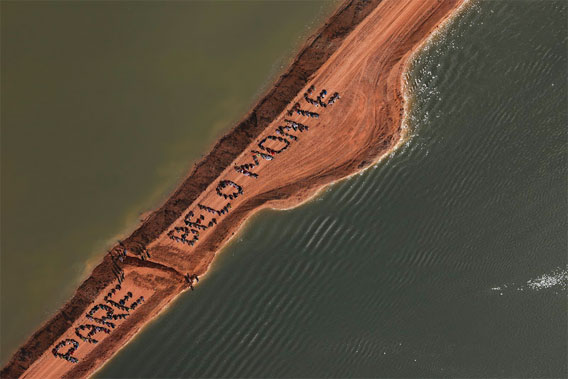
Belo Monte will flood more than 40,000 hectares of
rainforest and displace tens of thousands of people. The project will
impede the flow of the Xingu, which is one of the Amazon’s mightiest
tributaries, disrupting fish migrations and potentially affecting
nutrient flows in a section of the basin.
They
will of course lose in the end like all native people have always lost.
You will be hard pressed to find a more environmentally destructive
power source yet here we have a very upbeat article titled Hot dam: Hydropower continues to grow on an environmental website:
Brazil, the second-largest producer of hydropower
worldwide, gets 86 percent of its electricity from water resources. It
is home to an estimated 450 dams, including the Itaipu Dam, which
generates more electricity than any other hydropower facility in the
world — over 92 billion kilowatt-hours per year.
The article also mentions Grand Coulee dam and the fact that the
United States gets about seven percent of its electricity from hydro. It didn’t mention that:
Kettle Falls, once a primary Native American fishing
grounds, was inundated. The average catch went from a historical average
of over 600,000 salmon a year to nothing. In one study, the Army Corps
of Engineers estimated the annual loss was over a million fish. The environmental impact of the dam effectively ended the traditional
way of life of the native inhabitants. The government eventually
compensated the Colville Indians in the 1990s with a lump settlement of
approximately $52 million, plus annual payments of approximately $15
million.
Interestingly enough, the above link also says:
In 2007, Grand Coulee generated the second-most energy
among US power facilities, after the Palo Verde Nuclear Power Plant at
26.78 TWh. Palo Verde has a lower nameplate capacity but operates at a
higher capacity factor, giving it slightly more annual output.
Which got me to thinking. There are over 1400 hydroelectric power
plants in the U.S. compared to 105 nuclear power plants. The 105 nuclear
power plants produce almost three times more energy …without destroying
a single ecosystem or native culture. I then read a little bit about
the Palo Verde Nuclear Power Plant:
Due to its location in the Arizona desert, Palo Verde is
the only nuclear generating facility in the world that is not located
adjacent to a large body of above-ground water. The facility evaporates
water from the treated sewage of several nearby municipalities to meet
its cooling needs. 20billion US gallons (76,000,000m³) of treated water
are evaporated each year. This water represents about 25% of the annual
overdraft of the Arizona Department of Water Resources Phoenix Active
Management Area. At the nuclear plant site, the wastewater is further
treated and stored in an 80 acre (324,000 m²) reservoir for use in the
plant’s cooling towers.
You will be hard pressed to find an more environmentally friendly power source.
Senator Bernie Sanders is using Grist Magazine to lobby against government assistance for nuclear energy on the grounds that it's a mature industry. I might agree with him if it really were a mature industry and if renewables really could carry the day without it. But it isn't, and renewables can't. Always irritates me to watch ignorant politicians screw with my children's' futures. As sometimes happens with my long-winded comments, the one I left over there got large enough to convert into a post over here.
Senator Sanders may have good intentions, but what's new? We don't need any more roads to hell paved by those. He's just another member of the generation that has been systematically misinformed by "the end justifies the means" anti-nuclear lobby and our sensationalist for profit lay media.
Do government subsidies ever pay off? The poster child for government subsidies that have paid off royally would have to be those for nuclear energy. There are presently about 60 nuclear power plants under construction around the world. Just off the press:
Westinghouse Electric Company and Ameren Missouri have entered into an agreement to respond collaboratively to the United States Department of Energy (DOE) Funding Opportunity Announcement (FOA) for developing and licensing the Westinghouse Small Modular Reactor (SMR).
Bernie and/or his co-writer said:
Whether you support nuclear energy or not, we should all be able to agree that with record debt, we cannot afford to continue to subsidize this mature industry and its multi-billion-dollar corporations. If the nuclear industry believes so fervently in its technology, then nuclear companies and Wall Street investors can put their money where the mouth is. Let them finance, insure, and pay for nuclear plants themselves.
I can't think of a more promising technology to subsidize. With all of the new nuclear technology coming down the road, you can't seriously call this a mature industry. Where's the legislation to end government mandated consumption of food-based corn ethanol (moonshine) which may quietly be starving hundreds of thousands to death annually?
Nuclear may be expensive up front, but it certainly has proven to pay off over time. I'm a big fan of renewables, but they are going to need a lot of help from nuclear, and never mind that renewables receive even greater subsidies and are even more expensive than nuclear per unit energy, not that this is necessarily a bad thing.
Nuclear energy has been around for about half of a century. Aircraft
technology has been around for about a century. By Senator Sander’s
reasoning, a Sopwith Camel is the equivalent of an F-22 Raptor. There
would be no F-22 raptor without government funding.