Touch here for mobile friendly version

Showing posts with label Bob Dinneen. Show all posts

Saturday, October 30, 2010

Biofuels Reduce The Biosphere's Capacity to Absorb Carbon


Brace yourselves for another thought exercise.

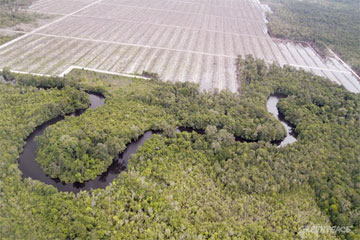
Expanding Croplands Chipping Away at World's Carbon Stocks
:

The conversion of the planet’s ecosystems into cropland — particularly in tropical rainforests — is stretching the Earth’s ability to store carbon, according to a new study. The demand for new agricultural land is growing most rapidly in the tropics, due to growing populations, changing diets, food security concerns, and a rising demand for biofuels.


Tim Searchinger is a researcher who has been published in the prestigious journal Science at least five separate times by my count. His, in hindsight, rather obvious, common sense observations have become a serious thorn in the side of the biofuel industry.

He was one of the first to raise the alarm about indirect land use issues (using corn for ethanol sent a price signal to clear more farmland from carbon sinks). He was the first to point out that government subsidies for biomass will aggravate global warming by motivating people to cut down trees. Burning trees to make electricity will release their carbon into the atmosphere. The seedlings planted to replace those trees will take decades to remove that carbon and store it again. Meanwhile, the CO2 from the trees that were burned will heat the planet for decades. We don't have decades.

Because of the great potential for profit, attention has focused on technology (hybrid and electric cars, solar, wind, nuclear, biofuels, and biomass) that will release less CO2. Very little attention has been paid to the other half of the global warming solution (getting the excess CO2 back out of the atmosphere) because nobody has figured out a way to get rich by just leaving forests and grasslands alone.


Photo by Mongabay

Case in point, Mongabay has an article up titled Scientists blast greenwashing by front groups:

The Consumer Alliance for Global Prosperity (CAGP) is a new group based in Washington D.C. that has launched a campaign against American firms that have adopted sustainability criteria in their sourcing policies. Companies targeted consist mostly of retailers that have dropped APP [Asia Pulp & Paper] from their stores, including Office Max, Staples, and Office Depot, but not Walmart, which has cut ties with APP except for its Walmart China division. The Consumer Alliance for Global Prosperity claims that these corporations are colluding with unions and "radical environmental activists" to hurt consumers in the United States.

"The 'Empires of Collusion' continue to push an anti-prosperity, anti-trade agenda," CAGP says in its campaign materials. "This coordinated campaign is run by radical environmentalists and others against the producers of pulp and paper from the developing world, destroying the livelihoods and aspirations of thousands of the world's poor."

"This initiative will fight back against anti-trade, anti-prosperity collusion among international Green NGOs, American trade union bosses, and corporations looking to eschew the rigors of a competitive marketplace."


How much a given biofuel reduces production of CO2 depends on how much fossil fuel is used to make that biofuel. No crop-based biofuel is carbon neutral. Cane ethanol and palm oil biodiesel come the closest but they all increase greenhouse gases to one degree or another.

But, unlike fossil fuels, the usurpation of water and arable land to grow biofuels inversely impacts our ability to allow forests and grasslands to remove the CO2 that's already in the atmosphere (as well as the CO2 being added with each gallon of biofuel burned). This is an extra downside to biofuels that fossil fuels don't share. Put another way, today's crop-based biofuels are hogging up the land and resources we need to store carbon.

In a nutshell, agrofuels are a dead end idea, a dog barking up the wrong tree. There are many ways to reduce CO2 production other than simply exchanging gallon for gallon the fossil fuels in our gas hog cars for liquid fuels made from the rapidly unraveling fabric of our biosphere.

We must reduce CO2 production while increasing CO2 absorption: Absorption/Production > 1, or Production < Absorption.

Until some biological process absorbs it, CO2 tends to stay put. Plants are the only means we have of removing excess CO2 from the air and safely storing it as carbon. In theory, if we could grow enough plants we would not have to cut back on fossil fuel use to avoid global warming because those plants would absorb and then store all of the CO2 produced by the fossil fuels. This would require roughly tripling the amount of land covered by forest and grassland. Unfortunately, that much water and unused arable land does not exist.

And keep in mind, those plants have to be alive to store carbon. They can't be used for fuel, or food (which is fuel for people).

The biofuel lobby appears to have concluded that this is one argument they are not going to win so they have switched tactics. No longer do they mention greenhouse gases or global warming in their press releases. Instead, they stick to exaggerating claims of clean air and job creation, while fanning the flames of xenophobia by suggesting corn ethanol is a stepping stone to energy independence (when in reality, it has hogged up all of the market leaving nothing for potential next generation fuels).

It seems that few people are interested in just leaving forests and grasslands alone to absorb carbon. The whole idea seems somehow wasteful. Where's the money in that? Global warming is essentially a shot across the bow warning us that we have finally exceeded a planetary limit. Speaking of which, and as icing on the biofuel cake, biofuels are also exacerbating other planetary limits.

Click here--to see a list of articles and to subscribe to future posts or subscribe by email:

Enter your email address:

Delivered by FeedBurner

Thursday, October 21, 2010

EPA approves E15--Bob Dinneen unsatiated


Bob Dinneen, head of a very well-funded corn ethanol lobbying organization, has a new press release in the Huff Po green blog which begins by claiming:

Other nations, including Brazil, with at least as many older vehicles on their roads, allow higher levels of ethanol blends with no discernible damage to their cars and light trucks.

In reality, unlike American cars, cars in Brazil where ethanol blends have been 22% since 1993 are all designed to run on that higher blend. According to Wikipedia:

"All Brazilian automakers have adapted their gasoline engines to run smoothly with these range of mixtures, thus, all gasoline vehicles are built to run with blends from E20 to E25, defined by local law as "Common gasoline type C". Some vehicles might work properly with lower concentrations of ethanol, however, with a few exceptions, they are unable to run smoothly with pure gasoline which causes engine knocking, as vehicles traveling to neighboring South American countries have demonstrated.."


Next he tells us about a study conducted specifically "for" his lobbying organization and paid for in part by the Illinois Corn Marketing Board:

In fact, the internationally recognized automotive-engineering firm, Ricardo, Inc., recently conducted a study for the Renewable Fuels Association [my emphasis] that used EPA's own engineering assessment methodology to determine the efficacy of E15 in vehicles MY2000 and older [not exactly true, the study went back only 6 years]. The report concludes: "... the adoption and use of E15 in the motor vehicle fleet from the studied model years should not [my emphasis and note they did not use the term "will not"] adversely affect the vehicles or cause them to perform in a sub-optimal manner when compared with their performance when using the E10 blend that is currently available."

Hmmm, who to believe? An organization chartered to protect the environment or a company that designs fuel systems for the car industry? Your call. According to the Ricardo study:

Six automotive manufacturers were identified as representing the overwhelming majority of vehicles sales for the study period, and the top selling platforms of these manufacturers thus became the focus of the Ricardo study. This approach enabled Ricardo to carry out engineering analysis without individually inspecting or testing each of this very large number of vehicles.

...this study demonstrates for the first time that raising the blend ceiling to E15 is "likely" to have a "negligible" [my emphasis] impact on vehicles manufactured between 1994 and 2000.

That's right. They only actually physically tested a handful of cars. In other words, if a 15 percent blend screws your car up immediately, or slowly over time, too bad for you because they never said it wouldn't, they said the higher blend is "likely" to have a "negligible" impact.


Bob goes on to tell us that EPA mandated labels on gasoline pumps to warn consumers that they are about to put a 15 percent blend into their cars "will ...confuse gasoline marketers, retailers and consumers.."

I own four cars (because my family has four drivers--myself, my wife, and my two daughters who are still in school). Half of our cars are quite a bit older than the study covered using statistical methods. What about all the poor people in America driving older cars, Bob? Is your organization going to pay their repair bills, (assuming the Ricardo study is correct, which is not "likely")?

...while making it more difficult for the nation to transition from imported oil to clean-burning, American-made renewable fuels. As it says in Scripture, "For if the bugle produces an indistinct sound, who will prepare himself for battle?"

Above Dinneen(along with quoting scripture that references violence), continues to claim that corn ethanol can scale up to the point of replacing imported oil. It can't. Using a third of our corn crop it barely displaces five percent of our gasoline use. And this fuel is not what you could call clean. In addition to being the major cause of the Gulf of Mexico dead zone:

http://www.stanford.edu/group/efmh/jacobson/E85PaperEST0207.pdf:

"..Due to its ozone effects, future E85 may be a greater overall public health risk than gasoline.."

http://www.pnas.org/content/early/2009/02/02/0812835106.full.pdf:

"health costs are $469 million for gasoline and $472–$952 million for corn ethanol, with the higher totals coming from coal-fired production."

http://www.sciencedaily.com/releases/2009/12/091214101408.htm:

"..would likely worsen health problems caused by ozone, compared with gasoline, especially in winter.."

Although his overarching concern appears to be national security, below he plays the global warming card:

On the environmental front, according to an analysis conducted by the EPA, ethanol reduces greenhouse gas emissions by 61 percent, compared to gasoline.

Actually, according to this NRDC article:

At its worst, lifecycle GHG emissions from corn ethanol exceed those from gasoline in all three scenarios. At its best, corn ethanol is not that much better than gasoline on a climate basis, and certainly not good enough to warrant the soil degradation, water resource depletion and water pollution it continues to cause.

Bob continues distorting reality:

On the economic front, the US ethanol industry supports nearly 400,000 jobs

Actually, according to this NRDC article:

"..by some estimates, fully 2/3rds to 3/4ths of the jobs were already there... But US farmers would have been growing crop any way thanks to domestic agricultural subsidies and just exporting more than we do today. Thus if there’s any significant job creation in agriculture, it’s probably internationally where farmers are trying to make up for the higher level of exports our farmers would have been able to supply."

Next, Bob tells us ethanol paid $15.9 billion in federal, state and local taxes. What he does not tell us is that those taxes would have been paid by the gasoline the ethanol replaced, so no new income was generated as he suggests.

When it comes to energy security, the production of a record 10.75 billion gallons of ethanol last year replaced 364 million barrels of oil that would otherwise have been imported from unstable nations with unfriendly governments, such as Hugo Chavez's Venezuela and Mahmoud Ahmadinejad's Iran.

America has not imported any oil from Iran since the hostage crisis during the Carter administration and 10.75 billion gallons barely represents five percent of our gasoline use. Considering that it took about a third of our corn crop to do that it's easy to see that corn ethanol can't scale up enough to provide a modicum of energy security.

Meanwhile, the Blend Wall also stands in the way of developing the next generation of biofuels from feedstocks such as woodchips, corncobs, native grasses, and even garbage.

The above quote is a beautiful example of what Orwell called "doublespeak." In reality, it is thanks to corn ethanol that there is little market left for alternative versions of ethanol. It has hogged the entire market up for itself. The greatest impediment to alternative forms of ethanol ...is corn ethanol.

Click here--to see a list of articles and to subscribe to future posts or subscribe by email:

Enter your email address:

Delivered by FeedBurner

Thursday, May 20, 2010

The Bobs--Corn Ethanol's Dynamic Duo


Photo courtesy of Chuckumentary via Flickr

"Could it be the unholy alliance between oil interests and environmentalists?"--Bob Dinneen, CEO of the RFA

*Bob Dinneen (the Bob on the right) is the CEO of the RFA, a corn ethanol propaganda mill lobbying organization that never prints the word "corn" next to the word "ethanol." Note also that he has dropped the whole "energy independence" canard for a new one called "reduce America's reliance on oil." This is because ethanol exports (including some to the Middle East) are going ballistic because ethanol refiners are getting a better price from foreign consumers. Bob's job is to attack anything and anyone critical of corn ethanol.

One tactic used is to publicly denigrate individual researchers who have findings not conducive to corn ethanol:

Environmentalists who have attacked ethanol on the basis of ILUC have relied, almost exclusively, on a highly speculative study by non-scientist, Tim Searchinger.

By my count, this "non-scientist" has been published five times in the prestigious journal Science (including the above referenced study), an honor most researchers don't obtain once in their entire careers. Brace yourself Science, you are undoubtedly next on the RFA hit list.

However, the latest research by Purdue University reflects the scientific community's rejection of Searchinger's initial paper that brought the ILUC issue to the front burner in February 2008. Since then, the estimated emissions purportedly occurring from ILUC penalty have fallen by nearly 90%. Rather than acknowledge the evolution of the science, Big Oil's environmentalists say nothing.


Here we have Bob trying to cherry pick his science. In this case he picks a study from Purdue University (my Alma Matter) which he claims contradicts Searchinger (and by the way, it is done by economists, not scientists). Following are some direct quotes from those Purdue researchers:

"...with almost a third of the US corn crop today going to ethanol, it is simply not credible to argue that there are no land use change implications of corn ethanol."

"...show that ethanol could be a somewhat better option than previously thought for reducing greenhouse gas emissions."

"The third simulation, which Tyner said is probably the most accurate, reduces the amount of carbon dioxide that would be emitted by about 10 percent. But he warned that the numbers are still uncertain because the model contains many complex relationships..."
I don't link to Dinneen's rant because I don't want to draw traffic to it because that will just encourage the publisher to allow him to post more rants to draw more traffic to generate more ad revenue. I parse the rest of his article below:

The slow and tepid response from the nation's major environmental organizations to the massive and devastating oil well blowout in the Gulf of Mexico ...

He made that up of course. There was nothing slow or tepid about it. How do you know when a politician is lying? His lips are moving, and we are all painfully aware that corporate lobbyists are the ones pulling the strings that move those lips.

...stands in stark contrast to their sustained and voracious attacks on homegrown renewable fuels such as [corn] ethanol.

There is no "sustained and voracious" attack against ethanol. There is a lot of critique of corn ethanol policy, its costs to other citizens, and its environmental impacts and these critiques are coming from all over the place, not just from environmental groups (livestock farmers, food wholesalers, scientific researchers, duck hunters, recreation vehicle organizations, and on and on).

And corn ethanol isn't a "renewable" fuel. About 3/4 of the energy found in a gallon of corn ethanol comes from non-renewable fossil fuels. This is largely a process that converts coal and natural gas into ethanol. Note how he will not use the term "corn ethanol" even though that is what 99% of all ethanol used in this country is made out of.

Environmental organizations such as NRDC, Friends of the Earth and the Environmental Working Group have been working hand in glove with the National Petroleum Refiners Association to undermine expansion of America's renewable fuels industry.

He also made that up. The corn ethanol lobby just launched a gargantuan propaganda blitz to convince congress to reinstate the blender's subsidy, which is supposed to end this year. They want it extended another five years to the tune of about $34 billion taxpayer's dollars. The blender's credit is a bribe to petroleum refiners to blend more corn ethanol than they are already forced to blend by mandate laws. They get about fifty cents for every gallon of ethanol they blend into our gas supply. Click here to see my anti-propaganda propaganda blitz.

Oil companies already own a significant number of our corn ethanol refineries--liquid fuels are their bag, baby. They will own them all before it's over.

This should come as no surprise. Recently, The Nation magazine, not a bastion of conservative thought, in an extensive article highlighted the close relationship between major oil companies and some of the nation's major environmental organizations. "They [the environmental organizations] take money, and in turn they offer praise, even when the money comes from the companies causing environmental devastation." The article cites Christine MacDonald, author of Green, Inc., noting, "Not only do the largest conservation groups take money from companies deeply implicated in environmental crimes; they have become something like satellite PR offices for the corporations that support them."

Dinneen has cherry picked quotes from a diatribe he found in a liberal publication to support his own piece of crap. Liberals everywhere should be flattered that he thinks anything published in a liberal magazine must be accurate. The following is another quote from that article in the Nation:

I have stood in half-dead villages on the coast of Bangladesh while families point to a distant place in the rising ocean and say, "Do you see that chimney sticking up? That's where my house was... I had to [abandon it] six months ago."

Riiight, as if the ocean has risen enough in six months to cover an entire house ...eyes rolling.

This tragedy in the Gulf of Mexico is likely to be the largest ecological disaster our nation has ever experienced. It is likely to be worse than the Exxon Valdez and the 1969 Union blowout off the coast of Santa Barbara, California. The 1969 disaster helped mobilize the environmental movement, led to the first Earth Day in 1970 and paved the way for numerous environmental laws. Environmentalists focused on the importance of improving the safety of offshore oil drilling and called for ways to reduce America's reliance on oil.

In the above, he finally gets something right as he describes the oil spill and praises environmental organizations (the same ones who he attacks for opposing expansion of his corn ethanol product).

So far, this incident has only precipitated scorn from the environmental community toward those of us that had the temerity to state the obvious: if we invest more in renewable energy we wouldn't have to drill in ecologically-sensitive land or waters to begin with!

Not true. Most scorn is directed at offshore drilling although there certainly is some directed at lobbying organizations like the RFA for trying to take advantage of this disaster to hawk their product. Environmental organizations are all for investing more in renewable energy, but as I pointed out before, corn ethanol isn't renewable. Environmental organizations are against replacing oil with something that is in its own ways worse than oil.

Runoff from industrial agriculture is the primary driver of the Gulf of Mexico dead zone. It's a chronic unending, ongoing, slow-motion, ecological disaster that dwarfs this oil spill in size and longevity but does not make the headlines specifically because it is chronic and ongoing.

Could it be the unholy alliance between oil interests and environmentalists?

"Or could it be ...Satan?!" --Church Lady

This is what I would call (called) an unholy alliance:

Transgressing identified and quantified planetary boundaries

Environmentalists have spent millions of oil industry dollars to fight ethanol, concocting various strawmen and red herrings, namely Indirect Land Use Change (ILUC).

And again, not true. ILUC stands for indirect land use change. Dinneen wants you to believe that you can hand over thirty thousand square miles of land to corn ethanol that was being used for other things like wildlife habitat and various food crops without it causing farmers around the world to clear more land to make up for that loss of land to grow food instead of fuel. All you need is a modicum of common sense to see that.

Roughly a third of our corn crop was turned into fuel last year. Imagine the impact of turning it all into fuel. The same legislation that provided the subsidy bribe to oil companies to blend ethanol into our fuel supply set a limit of 15 billion gallons for corn ethanol's contribution to the ethanol supply for a reason. Otherwise, the RFA would happily turn all of our food into fuel.

That is why high-fructose corn syrup was invented and why corn has found its way into just about everything we eat. There is no other explanation for the fact that the price of corn has remained about twice as high as historical averages for the last three years even though farmers have planted historically high amounts of it. Typically when farmers plant huge amounts of corn the price drops because supply exceeds demand. Corn ethanol is making sure demand exceeds supply.

Second, and most unfortunately, this accident reminds us once again of the destructive power of oil. Are major environmental organizations so focused on climate change that they can avoid focusing on the devastation that an offshore oil accident can produce? Have they become so enamored with bringing Big Oil to the climate change negotiating table that they need to show their power by kicking ethanol, even when it is less polluting than oil [not true] and where a spill has little discernible or lasting impact on the environment [not true]? We hope that like a condemned man who finally sees the light, environmental organizations now realize that renewable ethanol [not true] represents a cleaner [not true], less polluting [not true] future.


Renewable ethanol is one thing, corn ethanol is another, the Gulf of Mexico dead zone is rather irrefutable evidence of corn ethanol's longevity and impact on the environment.

when compared to the search for, production, importation and consumption of oil. I for one am not holding my breath.

Riiight. This isn't about energy independence. It's about profit. European officials estimated that 80 percent of U.S. biodiesel production was exported in 2008 and corn ethanol exports are starting to surge as well. The corn ethanol industry will sell to the highest bidder, even if that bidder is in the Middle East. From Ethanol Producer Magazine:

Washington – Ethanol exports have boomed in recent months, with shipments destined for dozens of energy-thirsty nations around the globe, including some in the Middle East. The United States has been a net importer of ethanol for the last decade, but the nation is quickly evolving into a net exporter. While this is welcomed news to an industry looking for new markets, it serves to undermine the fundamental value of America’s ethanol industry as a domestic replacement for imported oil.

The RFA of course has cobbled together a new list of excuses for why they are now exporting fuel, you know, like, "Well if the government won't let us force more of this down our fellow citizen's throats while simultaneously forcing them to subsidize it, then we will just have to export it to the highest bidder." Which will always be true anytime there is a higher bidder offshore, regardless of how much we are forced to consume domestically. Short of making it illegal to export our energy independence, they will export it.

[Update 5/27/2010] A paper published in Ambio, the journal of the Royal Swedish Academy of Sciences, found that by 2050 there will barely be enough land and water to grow enough food with nothing left over to grow biofuels:

http://www.tsl.uu.se/uhdsg/Publications/Ambio_Agriculture.pdf

Here, I adapted a chart found on the Oil Drum to show how we have to expand land use to meet biofuel mandates. It shows what will happen if we stay on our present course and don't usurp rainforests and grassland carbon sinks.


*Photo linked to RFA Flickr account. Taking bets this photo will soon disappear from that address.

Click here--to see a list of articles and to subscribe to future posts or subscribe by email:

Subscribe to Biodiversivist by Email