Touch here for mobile friendly version

Showing posts with label global warming. Show all posts

Saturday, May 7, 2016

Articles of Interest and Commentary--5/7/2016

 Cross-posted at Energy Trends Insider

Green Tech Media


I Was Wrong About the Limits of Solar. PV Is Becoming Dirt Cheap

by David Keith


Although quite upbeat about solar PV (and I'm also a big fan of solar PV), this article generated almost 300 comments because it was also frank about the limits of solar PV, and wind, and to make matters worse, he concluded the article with the following statement:
My view is that only two forms of energy -- solar and nuclear power -- can plausibly supply tens of terawatts without a huge environmental impact.
This is tantamount to blasphemy in most green (whatever exactly that means) technology websites. Which explains much of the action in the comment field but one comment in particular by Susan Kraemer caught my attention. She feels that CSP (concentrated solar power) with molten salt for heat storage is the answer to solar intermittency. I found this interesting because she had recently written an article at Earth Techling titled How a Hotter Climate Destroys Thermal Electricity Generation. CSP is thermal electricity generation (spins turbines with hot gases and must dump waste heat). The irony (is that the right word?) is that I had explained this to her in a comment under her article:
Thermal power simply becomes less efficient. It will be no more "destroyed" than solar photo voltaic:

"As part of Power System Program of the International Energy Agency (EIA), a study was conducted to analyze data from 18 grid connected PV plants located on different geographic locations and it showed a direct relation between temperature and PV module efficiency. The plants were located in Austria, German, Italy, Japan and Switzerland. The study concluded that 17 out of the 18 systems showed annual losses in efficiency due to temperature changes by 1.7% to 11.3%."

Also, solar thermal power plants have the same efficiency loss as any other thermal power source.

So, that leaves wind. Nobody is planning to run civilization only on wind. The future will be some mix of wind, solar, hydro, and nuclear with just enough natural gas to stitch them all together. The fact that higher temperatures will reduce efficiency is just something engineers will compensate for, and the lower efficiency would, all things being equal, result in higher prices, but I suspect the price difference will be negligible.
...you can lead a horse to water.

But the the study she wrote about also pointed out that hydro, the undisputed king of renewable energy, is going to be in a world of hurt. There are a lot of environmental bloggers out there without any kind of engineering background who write about energy issues, and the fact that they don't always understand the engineering principles behind what they write is obvious, at least to an engineer.

VOX

VOX doesn't allow comment under its articles. I try to make it a policy not to provide links for (or usually even read) articles without comment fields under them. Comment fields go a long way to keep blog authors honest. Would you buy stuff on Amazon from a retailer that does not allow reviews of their products? Me either. Why should you have to buy what an author says without seeing what reviewers think? I'm making an exception in this case because I'm essentially providing a comment field for these articles and anyone is welcome to participate.

Two articles by Dave Roberts caught my attention.

Friday, July 29, 2011

Reflective Metal Roofing--Cost Effective Guilt Relief


A few days ago I designed a device to prevent the detritus that comes through my gutter downspout from clogging the drain pipe it feeds into. I won't bore you with the details. My roof is getting old and the grit from the tar shingles is coming loose.

I noticed the water was tar colored. This can't be good for runoff water quality. This got me to thinking about metal roofs.

They can be painted a light color to reflect solar radiation and are preferred for solar panel installations. They can also be recycled.

According to this study, a 30-foot-wide by 30-foot-long white metal roof would reflect enough solar radiation (depending on where you live and roof pitch) to offset roughly 10 tons of CO2, which coincidentally is about how much CO2 equivalent the average American house emits annually.

That's right, you can offset your home's CO2 footprint with a simple reflective colored metal roof. I suspect it would also reduce air conditioning costs and related emissions as well. That's a lot cheaper than trying to do it with solar panels. The combination of a white metal roof and solar panels could double the impact of just one or the other, depending. It's one of those rare "can't lose" situations.

And according to the EPA, this is what you would be offsetting:

The three main sources of greenhouse gas emissions from homes are electricity use, heating and waste. Emissions from electricity generation occur at the power plants that supply your electricity. In the U.S. , greenhouse gas emissions associated with home electricity use are about twice those associated with heating. The greenhouse gases associated with waste from your home occur at the landfill that receives your garbage.


My next roof will be metal.

Photo courtesy of jahluka via Flickr

Click here--to see a list of articles and to subscribe to future posts or subscribe by email:

Enter your email address:

Delivered by FeedBurner

Saturday, June 25, 2011

Greg Laden: Please bend over while I kick your freakin ass


What does this video have to do with global warming, nuclear energy, or Greg Laden? I'll get to that later and my apologies up front for that title. I adapted it from an old 2007 blog article by Laden titled:

"James Watson:Please bend over while I kick your freakin [80-year-old] ass" [words in brackets are my own and ah, were added for clarity].

...which, admittedly, I found while doing a Google search on the text string: greg laden pompous a**. I was doing that search because Laden had been calling his readers names again in the comment field of his blog at ScienceBlogs.com.

As I mentioned in a previous article, Laden often turns his spot at ScienceBlogs over to a third party (29 times and counting) to dump their collection of lay press news articles about the damaged Fukushima power station. Following is a very recent quote from chemical engineer and (liquid) energy expert, Robert Rapier about the lay press (unrelated to nuclear energy):

Many politicians lie, pander, and promote misinformation to get elected. I have come to the conclusion that many media outlets do the same to sell papers. The casualty in both cases is a citizenry whose views on energy are perpetually distorted, and that leads to a perpetually dysfunctional energy policy.


In general, you can't rely on the lay press for accurate information about anything more complex than sports scores (just ask Arianna Huffington) but apparently Laden hasn't quite figured that out yet.

You also can't rely on the anti-nuclear activists to tell the truth (just ask environmental journalist, George Monbiot):

The unpalatable truth is that the anti-nuclear lobby has misled us all

The double standards of green anti-nuclear opponents

While doing that Google search I also stumbled upon an article by Laden plugging Jim Hansen's book Storms of My Grandchildren. I also read it and learned that Hansen is a huge proponent of using nuclear energy to fight global warming. Here is what Laden said about the book:

James Hansen is probably the world's best known climate scientist, partly because of his own work and his testimony before Congress, and partly because he has become a target of Global Warming denialists who seem to revel in every opportunity to accuse him of fraud, deceit, or incompetence.

...

This is "An Inconvenient Truth" on steroids. The book is well written, well presented, captivating, and depressing. The perfect Christmas gift for your favorite climate geek, or even your favorite denialist!


So ...go figure. The roads to hell are many and well-paved.

Oh, and about the video. After watching it, what would you say the odds are that the majority of American citizens will ever be convinced that global warming is anything more than just another liberal "belief?"

Reducing GHG emissions will only be accomplished as a side effect of eliminating the combustion of organic materials, be they ancient fossil versions or the modern biofuel version. They will not be reduced by convincing the majority of Americans that global warming is real (or by calling proponents of nuclear energy names and cobbling up excuses for banning them from commenting on your blog).

Here are the three comments leading up to the expulsion of that reader:

HP, sorry, your very informative comment was held in moderation until just now.

Looking at your comment and my post, though, I think you failed to answer Andrew's question. I'd love to know what I got wrong so I can fix it. Or are you just going to continue to be a self congratulating undocumented (as in, we really have no idea who you are) obnoxious shit, as usual?

Posted by: Greg Laden Author Profile Page | June 23, 2011 10:21 PM


Self congratulating obnoxious shit ...says the pot to the kettle. Note that Laden is one of the few (if not the only) person at ScienceBlogs to name his blog after himself.

Comment fields are a new phenomenon. It always amuses me to watch male hominids say (from behind the safety of their firewalls) things they would never say to another male hominid sitting within arm's reach on an adjacent bar stool, who might reach over, put you in a head lock and buff a shine on top of your head with their sweater sleeve. Any student of human nature knows what will happen when one upright walking male hominid disses another. The retaliation instinct kicks in:

Greg -

Why does it matter to you who I am? Are you a sucker for Argument From Authority? My comments are scientifically sound, though that may be obnoxious shit for you. Too fucking bad. Defend your arguments against my arguments, not who I am.

I fully answered Andrew's question, but I will provide an analogy for the Landenites.

Suppose I put you in a room with 100 malaria-Laden mosquitos for an hour. Your Exposure is 100 mosquito-hours.

But if only three mosquitos bite you, then your Dose is 3 mosquito-hours.

Exposure is different than dose.

I don't expect too many people reading this blog to understand the difference. Hopefully there is one or two.

Posted by: healthphysicist | June 23, 2011 10:33 PM


Laden closes the trap and gives another critic the boot:

HP: Again, you are being obnoxious. You are abusing the privilege of anonymity by acting in a way no one would (usually, normally) act if we knew your name, but for no good. You're not using your anonymity for an good purpose here. I am not a sucker for argument from authority, but you have made the argument from authority, and have not seen fit to back up what your qualifications are.

I may be wrong about what Andrew was asking, but I think he was asking you not to blather on about exposure and dose, but to point out where in this post it was wrong. Which you have not done.

I don't expect too many people reading this blog to understand the difference. Hopefully there is one or two.

Oh. You just insulted my readers.

Bye.


How noble, protecting his readers in this fashion.

I was once accused by a commenter of not being a PZ Meyers. I was honored that anyone would even compare me to Meyers, who I have tremendous respect for. I often read his blog Pharyngula (note that he did not name his blog after himself). The comments are the best part. Because he is so well-informed, smart and witty, he attracts an army of really well-informed, smart, witty people there. Just last week one of his minions touched my forehead with her noodly appendage at a the Fremont Solstice parade.

Meyers can afford to be cocky. Landen, not so much, particularly when he strays outside of his field of expertise.

Saturday, October 30, 2010

Biofuels Reduce The Biosphere's Capacity to Absorb Carbon


Brace yourselves for another thought exercise.

Expanding Croplands Chipping Away at World's Carbon Stocks
:

The conversion of the planet’s ecosystems into cropland — particularly in tropical rainforests — is stretching the Earth’s ability to store carbon, according to a new study. The demand for new agricultural land is growing most rapidly in the tropics, due to growing populations, changing diets, food security concerns, and a rising demand for biofuels.


Tim Searchinger is a researcher who has been published in the prestigious journal Science at least five separate times by my count. His, in hindsight, rather obvious, common sense observations have become a serious thorn in the side of the biofuel industry.

He was one of the first to raise the alarm about indirect land use issues (using corn for ethanol sent a price signal to clear more farmland from carbon sinks). He was the first to point out that government subsidies for biomass will aggravate global warming by motivating people to cut down trees. Burning trees to make electricity will release their carbon into the atmosphere. The seedlings planted to replace those trees will take decades to remove that carbon and store it again. Meanwhile, the CO2 from the trees that were burned will heat the planet for decades. We don't have decades.

Because of the great potential for profit, attention has focused on technology (hybrid and electric cars, solar, wind, nuclear, biofuels, and biomass) that will release less CO2. Very little attention has been paid to the other half of the global warming solution (getting the excess CO2 back out of the atmosphere) because nobody has figured out a way to get rich by just leaving forests and grasslands alone.


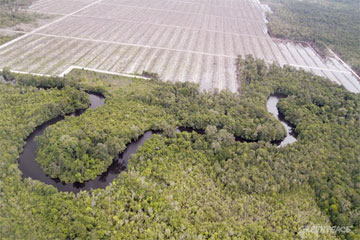
Photo by Mongabay

Case in point, Mongabay has an article up titled Scientists blast greenwashing by front groups:

The Consumer Alliance for Global Prosperity (CAGP) is a new group based in Washington D.C. that has launched a campaign against American firms that have adopted sustainability criteria in their sourcing policies. Companies targeted consist mostly of retailers that have dropped APP [Asia Pulp & Paper] from their stores, including Office Max, Staples, and Office Depot, but not Walmart, which has cut ties with APP except for its Walmart China division. The Consumer Alliance for Global Prosperity claims that these corporations are colluding with unions and "radical environmental activists" to hurt consumers in the United States.

"The 'Empires of Collusion' continue to push an anti-prosperity, anti-trade agenda," CAGP says in its campaign materials. "This coordinated campaign is run by radical environmentalists and others against the producers of pulp and paper from the developing world, destroying the livelihoods and aspirations of thousands of the world's poor."

"This initiative will fight back against anti-trade, anti-prosperity collusion among international Green NGOs, American trade union bosses, and corporations looking to eschew the rigors of a competitive marketplace."


How much a given biofuel reduces production of CO2 depends on how much fossil fuel is used to make that biofuel. No crop-based biofuel is carbon neutral. Cane ethanol and palm oil biodiesel come the closest but they all increase greenhouse gases to one degree or another.

But, unlike fossil fuels, the usurpation of water and arable land to grow biofuels inversely impacts our ability to allow forests and grasslands to remove the CO2 that's already in the atmosphere (as well as the CO2 being added with each gallon of biofuel burned). This is an extra downside to biofuels that fossil fuels don't share. Put another way, today's crop-based biofuels are hogging up the land and resources we need to store carbon.

In a nutshell, agrofuels are a dead end idea, a dog barking up the wrong tree. There are many ways to reduce CO2 production other than simply exchanging gallon for gallon the fossil fuels in our gas hog cars for liquid fuels made from the rapidly unraveling fabric of our biosphere.

We must reduce CO2 production while increasing CO2 absorption: Absorption/Production > 1, or Production < Absorption.

Until some biological process absorbs it, CO2 tends to stay put. Plants are the only means we have of removing excess CO2 from the air and safely storing it as carbon. In theory, if we could grow enough plants we would not have to cut back on fossil fuel use to avoid global warming because those plants would absorb and then store all of the CO2 produced by the fossil fuels. This would require roughly tripling the amount of land covered by forest and grassland. Unfortunately, that much water and unused arable land does not exist.

And keep in mind, those plants have to be alive to store carbon. They can't be used for fuel, or food (which is fuel for people).

The biofuel lobby appears to have concluded that this is one argument they are not going to win so they have switched tactics. No longer do they mention greenhouse gases or global warming in their press releases. Instead, they stick to exaggerating claims of clean air and job creation, while fanning the flames of xenophobia by suggesting corn ethanol is a stepping stone to energy independence (when in reality, it has hogged up all of the market leaving nothing for potential next generation fuels).

It seems that few people are interested in just leaving forests and grasslands alone to absorb carbon. The whole idea seems somehow wasteful. Where's the money in that? Global warming is essentially a shot across the bow warning us that we have finally exceeded a planetary limit. Speaking of which, and as icing on the biofuel cake, biofuels are also exacerbating other planetary limits.

Click here--to see a list of articles and to subscribe to future posts or subscribe by email:

Enter your email address:

Delivered by FeedBurner

Monday, January 18, 2010

How I Reduced My Natural Gas Use 75 Percent for Less Than $1,400


(Photo credit VA5LF via the Flickr Creative Commons license).

[Update 5/04/2010] We had a record warm winter this year so I could not tell what the impact of the new furnace was. However, I just got a gas bill for a month where the average temperature was just one degree warmer than last year and my gas bill was considerably higher. Not cool. It is possible to use more gas with a 95% efficient furnace than an old 80% one. My guess is that the more powerful blower has been pressurizing my leaky ducts and forcing a lot of hot air out into my unheated basement. Sure enough, when I inspected the new duct installed on top of the new furnace I found a 1/4 inch wide by 2 foot long gap in the back. That leak alone is almost like having an extra furnace register to nowhere! I am now in the process of sealing all joints and will let you know what happens.


[Update 4/11/2010] A 2 inch diameter plastic plug fell out of the furnace today allowing the exhaust to dump strait into my basement. The technicians forgot to apply any PVC glue to it. This is a situation that could very easily be fatal to a sleeping family.

This is an update to a post I did last winter titled:

Weatherization Nation--How I reduced my natural gas use 60 percent for less than $400

In that post I speculated that getting the next 20 percent reduction (for my goal of 80 percent total) was going to cost more than the first 60 percent, which was the result of picking all of the low hanging fruit (weatherizing). It has cost me an additional $1,000 to date to get that last 15 percent by replacing my worn out 80 percent efficient furnace with a 95 percent efficient one. The price difference between an 80 and a 95 percent furnace is about $1,000, which I added to $400 to come up with $1,400, which I admit is creative book keeping because my new furnace cost a lot more than a $1,000.

My hot water solar panels are on hold until better weather. I've concluded that a heat pump hot water tank would not be cost effective for my application. I found a study where this concept was tested in different cities. The test done in Seattle showed very little gain for two main reasons. The tank was in an unheated basement (as mine would be) and the winter air temperature was too low to provide much energy. In addition, the winter temperature of tap water in Seattle tends to be quite cold because it is coming from snow melt.

If one of these is located in, say, a hall closet, it will act just like an air conditioner, cooling your house to heat your water causing your furnace to use more energy to heat your house back up for a net energy loss.

Putting one in an attic would work because a lot of hot air ends up there that you can't use. On the other hand, a hot water heater in an attic is asking for real trouble when it eventually springs a leak.

In short, if you can't find a warm place outside of your home's insulated and heated envelope for one of these, they probably won't do much for you during the heating season.

One day it dawned on me that my 80 percent efficient gas furnace is 20 years old. This is old for any appliance, especially a gas furnace. This led me to discover that my gas utility is offering a $350 rebate to anyone upgrading to a 90 percent efficient furnace. And to ice the cake, the stimulus package offers a 30 percent tax credit, up to $1,500, for the entire cost of upgrading to a 95 percent efficient gas furnace. The rebate and credit knocked $1,400 off the $3,600 cost.

This credit is analogous to the cash for clunkers program for cars in that it will use a lot of tax money to accomplish next to nothing environmentally. It's mostly an excuse to pump money into the sagging economy, and only a fool turns down a government handout.

One drawback to government meddling like this is that businesses tend to jack prices to capitalize on the credits, nullifying some of the benefits to the consumer to grab some for themselves. This happened to the Prius when the hybrid credit went into effect. Every contractor was trying to use the rebate and credit to make their bids appear lower. I asked them not to mention either in their bids so I could get a clear apples to apples price comparison.

With sales tax, I will end up paying $2,500 for a 77,000 BTU Lennox furnace with a variable speed motor and two stage burner.

This furnace should in theory account for another 15 percent decrease in gas use, thus my estimate of a 75 percent reduction from our normal gas bills. That makes me only 5 percent away from my 80 percent goal.

I chose this furnace design for two main reasons. The variable speed motor uses half the power of my old furnace (when on low), saving about 300 watt-hours for every hour it runs (on low). This will help with my efforts to reduce electricity use 80 percent, which I have not yet written about.

I wanted a two stage burner because my home's heating needs are modest by today's McMansion standards and the furnace should run most of the time with the blower at lower speeds and with only half of the burners ignited. The higher blower speeds and extra burners will come in handy on especially cold days but will for the most part remain on standby.

Let me share some things I learned so you don't have to climb up the same learning curve.

To achieve this kind of efficiency, today's higher end, 95 percent furnaces have reached ridiculous levels of complexity. All things being equal, complexity equates to higher cost and lower reliability in general. For this reason I registered with Lennox for their extended warranty, which is free at this time as a promotion, which is another reason I chose Lennox ...although more than one salesman told me that most of the major parts inside most furnaces are made by the same companies.

Thermostats have also reached ridiculous levels of complexity, especially if you have central air and heat combined, which I don't, thank God. There is little need for cooling in Seattle. Today's higher end thermostats communicate with the programmable circuit board in the furnace to do all kinds of worthless things, much like the never ending new and improved versions of Microsoft Word.

I refused to be talked into a fancy thermostat. I liked my bullet proof, but not very accurate, round mercury switch version that is about half a century old. I didn't want the technicians to even touch it. They touched it anyway and I'll get to that part in a minute.

The last thing you want is to wait for your furnace to fail in the middle of winter when you can't take the time to get multiple bids and are at the mercy of the sharks.

January is a good time of year to get bids from contractors because business tends to be a little slack, in part because nobody is in the mood to spend money after seeing their Christmas Visa bills, especially in this economy. I got seven bids and coincidentally chose the one right smack in the middle of the price ranges.

I threw out two of lowest bids because (after checking on the Internet) the model numbers listed were not for a variable speed two-stage furnace, as I requested.

The next lowest bid was only $170 less than what I accepted but was for a furnace that I was not sure would really qualify for the tax credit. The website claimed it was "up to" 95 percent efficient. The tax form says "at least" 95 percent efficient. Some companies have compromised on the efficiency percentage points to keep the price a little lower than competitors. They got caught by the hard and fast cutoff of 95 percent by the federal tax credit and have been scrambling to modify their furnaces so they can pass independent tests certifying that their furnaces are 95 percent efficient. The furnace contractor certainly would not be liable if the furnace ends up not qualifying a year after installation, so just because he says it will qualify does not mean it will.

The three bids that were higher were significantly higher, up to $1,500 higher for the same furnace I had installed.

The lowest bids were done by the business owners themselves. The higher bids were, not surprisingly, done by salesmen working on commission.

Green being the latest shtick, two of the highest bidders, although from different companies, arrived in Priuses with the words "hybrid heating and cooling" painted on their sides. One was a 2010 model with a solar panel built into the roof. Thanks to the Prius, the word "hybrid" has a lot of marketing appeal. I drive one myself, when my wife isn't using it ...

One salesman confided that they had tried to market solar panels but gave them up after several bad outcomes.

Another whipped out a laptop with a printer and started to do an energy audit of my house in order to pick the appropriate sized furnace. I told him not to bother because it would be meaningless in a home that incorporates night insulation window plugs, and passive solar heat gain. We also close the heating vents to the upstairs. In addition, I suggested that a two stage furnace may stay on the lower settings most of the time making the whole analysis of dubious value. Not to mention, the furnace sizes come in a few large increments so you are likely to be slightly over-sized or under-sized no matter what you do. I buried them with common sense and now I just have to hope I didn't screw myself somehow.

This salesman said I would have to sign a paper that I would not sue if the heating system is sized wrong. I called his bluff, didn't sign a paper, and they didn't get the job (this was the highest bid with the guy driving the 2010 Prius).

My new furnace arrived on a Monday morning, 1.5 hours after it was supposed to. The first thing I did was check the part number to make sure they were not going to try to install a similar but cheaper model. The only difference in the model part numbers was the letter "V" which stood for variable speed motor and the furnace laying in my garage floor did not have a "V" in the part number. I pointed this out to the technician (who was late because he had gotten lost) so he called his boss who insisted that this was the right furnace, even though the part number on the bid clearly had a "V" in it. He finally capitulated and said he would send another one out.

This was supposed to be a simple swap out. All they had to do was replace a short piece of ducting to transition from the new furnace, rearrange the gas pipe, and install the PVC exhaust ducts, all in a wide-open unfinished basement.

They kept trying to talk me into a new thermostat, I suspect because they had managed to break the thermostat wire off in the wall. They could not get a new wire up to my thermostat because of blocking in the wall. The technician had to remove my old thermostat and I had a feeling it would never be the same again. I finally got a hammer and chisel and cut a notch in my sheet rock around the blocking and dropped a chain to the poor technician who was at his wits end by now.

After all this they could not get the furnace to work because it had a bad inductor motor and we had to spend the night without heat.

After they left I inspected their work. The technicians had twisted and cocked the existing gas pipes rather than install proper lengths of pipe, giving the installation a Dr. Seuss look, with one pipe sitting on a switch that could not now be turned. The new duct didn't fit and had two one-inch wide gaps that they covered in tape. I could see that the furnace was not level from ten feet away and they ran the condensate line down my siding rather than into my mop sink as requested. Oh,and the filter was leaning up against the furnace at about a 30 degree angle with no way to secure it to the duct opening.

I called the boss and complained. The next morning I was not pleased to see a very pissed off technician at my door who informed me that he was there to rearrange the gas pipes "on his own time," that the furnace was supposed to lean in that direction, and one inch gaps were perfectly acceptable. I'm just hoping he did not run a screwdriver though the circuit board before he left, but at least the furnace now works.

I decided to replace my thermostat after all this because, oddly enough, it was no longer working properly. I wanted a simple, non-programmable unit and as usual turned to the internet for advice. I found one commenter who, after taking the advice of another commenter on how to hook up his thermostat, found that it had melted over night. Later I found the comment that had misled him on another thread. I wonder how many houses that jackass has burned down.

I also learned that you have to take what the contractors tell you with a big grain of salt. Trust but verify. They just want to sell you a furnace. It's a jungle out there. Good luck!

Click here--to see a list of articles and to subscribe to future posts or subscribe by email by adding your address to the box in the upper right hand corner of the blog.

Saturday, December 5, 2009

Climate Cover-up, a Review


This review follows on the heels of what the media has dubbed climtategate--a textbook example of how to make a mountain out of a mole hill. A few weeks prior to that brouhaha, the media was awash with reports that the world is actually cooling, which upon closer inspection also amounted to nothing. Sticking with mole analogies, correcting the disinformation perpetuated by those who seek to discredit climate research has become a perpetual game of Whac-A-Mole.

The book does a very thorough job of documenting the history of sometimes despicable attempts by various vested interests and contrarians to discredit climate science. There is no doubt which side holds the science high-ground on this issue and after reading this book there should be little doubt which side holds the moral high-ground.

It gets off to a slow start but hang in there. It gets better, ending with a bang. It is not a neutral perspective of the pros and cons of the global warming debate. This is a detailed, no holds barred account of the people who work to discredit climate science and the methods they use to do it.

The authors begin with a critique of octogenarian Freeman Dyson, the world’s most notable global warming skeptic. Dyson is in a class of his own and does not deserve to be lumped in with the usual ignoramuses, cranks, and conspiracy theorists. I suspect his mention at the front of the book was one of those last minute edit jobs in response to a NYT article about Dyson’s skepticism just prior to the book’s release. Climategate, the latest global cooling farce, and Dyson’s skepticism are all examples suggesting that an updated version of this book a year from now might be twice as long.

Dyson is an icon in the world of science and scientists don’t like it when anyone takes a pot shot at one of their heroes. Dyson is by all accounts a genius. He probably thinks people who use calculators are sissies. Back in the seventies, Dyson published a paper which calculated that we could stabilize carbon in the atmosphere by simply planting a trillion or so fast growing trees.

Intellectually speaking, I am but a speck of dirt on the bottom of one of Dyson’s shoes, but people who once proved brilliant in their field of expertise rarely prove to be quite so brilliant in unrelated fields, like climatology. Michael Jordon comes to mind.

Some climate models suggest that planting trees in the upper latitudes would have a warming effect because they would reduce reflectivity of snow on the ground. If true, this is an example of how humanity has already reached some points of no return. Out of curiosity, I just fired up a spreadsheet to calculate how much land mass a trillion trees would cover spaced at five foot intervals with a five foot square boundary around each. Dyson could probably do this in his head. Maybe I have a decimal point in the wrong place but according to my calculations they would cover the Earth’s landmass dozens of times over unused arable landmass more than twice over (see comment by Pete S).

The following was found in a publication describing a lecture Dyson gave in 2006:
“He had useful advice for his home planet, but he also puts most of his hope in the colonization of space and a future beyond our atmosphere. In outer space, he believes, there will again be speciation in the Darwinian sense.”

Following are some quotes from a NYT article:
“Forty years ago it was fashionable to worry about the coming ice age. Better to attack the real problems like the extinction of species and overfishing. There are so many practical measures we could take”

“I’m still perfectly happy if you buy me a Prius!” Imme [his wife] said.

“It’s toys for the rich,” her husband smiled, and then they were arguing about windmills.”

1) The ice age hypothesis was short lived, not widely accepted, and blown out of proportion by a lay media looking for sensationalist headlines, as always.

2) If we attacked all of the world’s problems (like overfishing and species extinction) linearly (one at a time) instead of in parallel, the sun would go dead before we got to the end of the list.

3) A Prius is not a toy for the rich.

Dyson is also a big proponent of solar power, so, go figure.

Skepticism is one of the keystones of science and anyone who wasn’t skeptical when they first heard about global warming should contact me so I can sell them some land in Florida. Likewise, the word skeptic might be appropriate for those who have been living in caves for the last decade and have just caught wind of the concept, but what do you call someone who refuses to move to the next stage regardless of the evidence?

The word denier was used 36 times in this book. Denial is also the first stage listed in Elizabeth Kübler-Ross' book, "On Death and Dying." (see the Wikipedia article on the Kubler-Ross model). Denial is the overarching reason for a belief in an afterlife. Acceptance of the results of decades of global warming research is not by any means tantamount to accepting one’s eventual demise, but the potential ramifications of global warming appear to be enough to send many people scurrying for their ostrich holes.

Much of the denial we see is probably related to the potential ravages of global warming. If the research results were suggesting that global warming has little potential and would have little impact, I doubt there would be any debate at all.

Few of us will live an entire life without facing situations that we find so threatening that we deny they are true, at least at first. Coping mechanisms help us deal with unpleasant realities until we can gather ourselves and face them, or not. But some people have become very adept, maybe too adept, at capturing the anxiety relief denial can provide especially when doing so will not have a negative impact on their daily lives. They have a hair-trigger reality switch that has been honed to a shine by repeated use, and few people who do it are consciously aware that they do it because awareness would deactivate the switch.

We of course pick and choose our denials. You could deny that walking in front of a speeding bus is dangerous but you would also be taking a big personal risk. Unlike some forms of denial, denying the potential ramifications of global warming entails no physical danger to the denier, only anxiety relief. It is custom-made for using denial as a coping mechanism. However, a prolonged and collective denial by enough people may have an impact on our children’s and grandchildren’s lives by radically altering the world they will live on. Collective, self-reinforcing denial may have been what brought the Easter Island civilization down.

There are plenty of other reasons not to accept the findings of decades of global warming science. You may just be ignorant or misinformed, or have a contrarian personality disorder that is not constrained by logic and evidence (conspiracy theorists fall into this group), but whatever reasons you have, they are not backed by science, regardless of what you may have told yourself to the contrary.

[Update 12/06/09]

An earlier review by Roberts can be found here on Grist. Denier debunking is like trying to kill zombies that won't stay killed.

Half of the review on the Guilty Planet blog is spent criticizing the authors for critiquing Dyson. She thinks that Dyson is qualified to critique climate science because of the "book" he wrote about using trees to absorb carbon back in 1977. I commented on the blog pointing out that he had not written a book, but had only published a paper. She didn't publish my comment, but I see she corrected that part about him publishing a book on the subject:

...the first entry that pops up is his 1977 [book] paper published in the journal Energy titled: "Can we control carbon dioxide in the atmosphere".

In a book [Climate Cover-up] that lauds accuracy so loudly, a misstep such as this so early on can be fatal ...

... Dyson is probably a bad early target for Hoggan, who should have stuck to the corporations (worthy of his energy), rather than making false claims about a venerable scientist. Climate Cover-Up recovers from this slip up but, as the old African proverb goes, one falsehood can spoil a thousand truths.

Spare me.

And take the time to click on this video (found on Pharyngula):


and if that was not enough, watch birth of yet another Climate Croc:

Saturday, October 31, 2009

WWF Study Puts Global Warming Into Perspective


I put together a Microsoft Excel interactive pie chart that can be opened or downloaded (file downloaded from this link is guaranteed not to have a virus) that may help people to put into perspective various efforts (like doubling the efficiency of the US car fleet, or the elimination of coal for electricity generation) to reduce greenhouse gases.

I read the WWF study last night. At first I was a little shell-shocked, but as I read on I grew numb hopeful. At least now we have a decent study that clarifies what needs to be done, how fast it has to be done, and most importantly, when these efforts need to get started. It's now or never. There will be no going back and no way to fix this if we don't get started now.

Following are several highlights I took home from the study.

There are four main drivers: Clean energy generation, energy efficiency, low-carbon agriculture and sustainable forestry.

Bioenergy comes with the following caveats:
“...no deforestation, no competition for land between bioenergy production and food production and protection of biodiversity and nature conservation.”
Bioenergy is potentially CO2 neutral. However, the expansion of palm oil and tropical crops, such as sugarcane, for biofuel production could become a significant driver of deforestation. Bioenergy developments must therefore be appropriately regulated to prevent further deforestation.


We will all have get to drive electric cars!

Since there are alternatives for land-based transport – but not for air and sea, as it stands today – the priority allocation of sustainable biofuels must be to the aviation and shipping sectors …energy demand from the land-based transport sector is met through grid-connected renewable sources…


They demonstrated that once renewable energy industries reach an economy of scale (a critical mass of sorts) they would from that point on become much cheaper than fossil fuels. Everything will cost less because energy will cost less. Investors are going to get their money back and then some. Fossil fuels will be left in the ground because they are no longer the cheapest option (or only option).

In the beginning, coal fired power plants must rapidly be retrofitted to burn natural gas. It produces about half of the CO2 as coal. Later, natural gas will have to be phased out as renewables come on line. We will have to limit other uses of natural gas to have enough to displace coal. Again, we will all have get to drive electric cars!

Growth of nuclear power was not assumed. They gave a few reasons for this. One is that the WWF has historically been opposed to it for all of the usual reasons. Another reason is that nuclear power can only grow fast enough to make a modest contribution in any case. They also noted that thanks to massive government meddling with subsidies, nobody has a clue what it really costs.

They mention the fact that a terrorist attack on some nuclear power plants could kill hundreds of thousands and cost hundreds of billions. After watching religious nutballs fly jets into the Twin Towers and Pentagon I don't know how anyone can still deny this possibility. [Update: This analysis indicates that a typical containment dome would protect a nuclear plant from an airliner attack. Also watch this video of a large fighter jet being crashed into a concrete block to see how an aluminum aircraft fairs against reinforced concrete.] By their calculations nuclear power is not a make-or-break part of the solution so why bother? These are all good arguments and if they are wrong on too many of their assumptions, well, we can build nuclear plants as well, accepting the risks as the lesser of two evils. A global warming tipping point trumps all.

Burning some fossil fuels but capturing the carbon (Carbon Capture and Sequestration) is one of the 24 main solutions although the authors acknowledge that this might not work and that there is a risk we will waste a lot of time and money to find that out.

They began by asking, "Is it is already too late to avert a catastrophic temperature rise? If the answer were yes I probably would not be doing this post. They concluded that it isn't too late but only if we land on our feet running within the next four years.

To figure out when we need to get started they looked at the history of free market industrial growth. By assuming industries like wind turbine manufacturing and efficient technology growth will grow at maximum known historical rates for industry, they could back off roughly when it will be too late to do anything. In other words, if we don't hit the ground running in the next four years, industries like wind turbine manufacturing will be incapable of growing fast enough to avert this coming train wreck.

There are a few graphs on the report that you might want to check out. See pages 13, 16 (return on investment), 36 (or 58), 105 (point of no return).


This scenario would take unprecedented political will. Political will is a function of what voters want. Politicians will not martyr themselves for the greater good if their ignorant constituency wants the opposite.

A recent poll has indicated that only 57% of Americans think there is solid evidence that the earth has been warming (down from 71% a year ago). Another poll taken on Darwin's anniversary earlier this year found that the majority of Americans (61%) don't buy the theory of evolution. On the other hand, we still teach the theory in our high schools.

If you have quit worrying about global warming because your favorite lay media outlet told you that the Earth hasn't gotten warmer for the last ten years (global warming has taken a break), you need to start worrying again. Maybe the first step to fight global warming should be to get rid of TV news and printed newspapers. This would force people to read blogs for information. At least the opposing viewpoint is there if you choose to look for it.