Touch here for mobile friendly version

Sunday, November 25, 2012

Ethanol Saved Consumers $134,400,000,000 in 2011?


Cross-posted from Consumer Energy Report


Back in 2009 two researchers released a study that suggested corn ethanol was saving American’s money at the gas pump. I wrote to one of the authors asking for clarification. His reply:
In the paper, we conclude that evaluated at the average ethanol production level of 01/1995-03/2008, the wholesale gasoline prices is $0.14/gallon lower. The change of retail gasoline prices varies across refinery markets from $0.29-$0.40/gallon.
He also added that the results were unique to prevailing conditions in 2009. According to Wheels, the report has been updated and now claims corn ethanol saved Americans a buck a gallon. However, thanks to ads trying to make hay from this study by the nation’s largest corn ethanol lobbying firm, aka, The Renewable Fuels Association, the study caught the attention of two other researchers:
Mr. Knittel of M.I.T. said in an interview that ethanol most likely reduced gasoline prices, at most, by 10 cents a gallon, after adjustments were made to account for the biofuel’s lower energy potential relative to pure gasoline. He described claims made by the trade group, which have appeared at bus shelters and billboards, particularly around Washington, as “false advertising.”
 Economic studies of this nature can be hard to refute because the only people qualified to critique them are other agricultural economists or statisticians. Common sense can only get you so far. However, Mr. Knittel and Mr. Smith are qualified to critique the study:
To illustrate their critique, the professors employed the same statistical models used in the Iowa State report to draw intentionally absurd conclusions, among them that ethanol production depresses the price of natural gas and increases unemployment in the United States and Europe. “We also used their model to show that ethanol production is causing my daughter to grow older, and if it was taken away she’d get younger,” Mr. Smith said in a telephone interview. “We know that’s not true, or at least we hope it isn’t true.”
Now that’s what I call good use of sarcasm. Shockingly, a spokesman for the RFA defended the scholarship their ad was based on, and never mind that he is no more qualified to defend it than you or I.
The study results are based on regional restraints on supply caused by refinery capacity, so the results will change if you enter a period of lower domestic fuel demand, increasing export of refined petroleum products, and record high prices for corn. Don’t expect to see results of the next study on any bus station billboards if it finds that ethanol is costing Americans $billions.
1200 x 112,000,000 = 134,400,000,000

Saturday, September 8, 2012

The Nuclear Energy Denier


 Cross-posted from Consumer Energy Report

I was rebutting a comment I found under a CER News Desk article titled: Utility Head: Japan Can’t Afford Renewable Energy, Needs Nuclear when I realized I had generated enough material for an article. Here is a similar article titled Green energy to hit Germans' bills.

What labels would you choose for yourself?
  1. Renewable Energy Advocate
  2. Nuclear Energy Advocate
  3. Renewable Energy Denier
  4. Nuclear Energy Denier
I would choose labels 1 and 2. I used the term "denier" in my title only to make a point. I don't know who first applied the term "denier" to global warming skeptics but I have never used the term quite simply because it is hateful. I've also seen the terms "green energy denier" and "Chernobyl denier" used (see Radioactive Wolves!).

Global warming skeptics are not in any way analogous to the nut jobs who deny the Holocaust or the AIDS epidemic as the term is meant to insinuate. From Wikitionary:

Person who denies something.
Holocaust denier (see Wikipedia:Holocaust denial)
Global warming denier (see Wikipedia:Global warming denial)
AIDS denier (see Wikipedia:AIDS denial)

The renewables verses nuclear debate is as disingenuous as it is nonsensical. They are not mutually exclusive. They both replace fossil fuel as a source of carbon emissions. Renewables should be viewed as an alternative to fossil fuels, not nuclear.

Read The Nuclear Enhanced Renewable Grid (NERG) and Reframing Nuclear Power as an Ally of Renewable Energy.

As usual, environmental journalist George Monbiot is ahead of the curve on this issue. In a letter he penned to David Cameron earlier this year countering the letter sent to him "by four former directors of Friends of the Earth" Monbiot says:
"For nuclear and renewables, as the Climate Change Committee has rightly pointed out in numerous reports, this is not an either-or choice; we need increasing deployments of both in the UK’s energy mix in the future (see appendix 1). Thirdly, the 12 March letter focuses significantly on economics, in short, arguing that nuclear is too expensive. We would point out that even if this were true, the writers themselves would have helped make it so by devoting decades to campaigning against the technology during their tenures at Friends of the Earth. In addition, if anyone has yet invented an inexpensive low-carbon energy source, we have yet to hear about it – Friends of the Earth today campaigns vociferously in favour of the retention of the solar feed-in-tariff, which delivers perhaps the most expensive, unreliable and socially regressive electricity ever deployed anywhere. Once again, we would refer you to the Climate Change Committee, which found that nuclear was potentially the cheapest of all low-carbon options available by 2030 (appendix 2)."
Although not a single talking point in the following comment I address is novel (few thoughts are), and not a single footnote to a source was proffered, the comment serves a larger purpose by providing me an opportunity to express some critical thought. I don't want the commenter to feel singled out and welcome him to continue to participate, but I would also like to suggest that he take the time to provide links to sources so the audience knows who the originators of the talking points are and so they can assess the quality of the sources of the information he passes along. I know of one site that does not allow unsourced comment. I don't think this is necessarily a good idea because it has a tendency to spill over into censorship.They do this in an attempt keep the comment field from becoming a come-one-come-all liar's club (although most people are inadvertently passing along information they don't realize--or care--is bunk).

George Harvey said:  
"According to the US Department of Energy in 2011, based on data taken in 2010, hydro, wind, biomass, and geothermal are all less expensive than nuclear..."
Which, if true, is at odds with the 2011 Department of Energy Quadrennial Technology Review that promotes the use of small modular reactors:
"The United States has traditionally taken a leading position in crafting the international civilian nuclear technology “rules-of-the-road” and has helped develop a sound technology base to implement and enforce those rules. With a current global deployment of 442 civilian nuclear power reactors and an additional 65 reactors currently in some stage of construction, civilian nuclear energy sits at the nexus of energy, climate, and security."
George continues:
"...even when costs to the consumer associated with waste and Price/Anderson insurance coverage are not included in the equation."
Those costs are already reflected in your very reasonable and competitively priced nuclear energy utility bill as an almost imperceptible surcharge.
"This challenges the concept of baseload power; when the wind is not blowing in one part of the country, it will be blowing in another."
If that were true they would have replaced their idled nuclear with wind instead of fossil fuels.
"...the questions that remain [about energy storage} are matters of fine-tuning... These things combine with the other challenges to the concept of baseload power to show it is actually mythology, a bogeyman created by those who can profit by it."
That is absurd. Baseload power isn't the result of backroom conspiracy theories. It's the inevitable result of a market seeking lowest cost solutions. Most renewable energy today is baseload. Read Dirty, Baseload, Centralized, Renewable Energy and A Baseload Free Power System.

Storage is rarely used quite simply because it is prohibitively expensive. For example, building a reservoir and pumping water into it can easily cost more than the stored energy is worth. Ditto for any number of other power storage schemes, like making hydrogen, or methane. And in cases where it can be economical, it can be used to improve the fficiency of any number of power sources, like nuclear for example, which could then provide peak power as well as baseload.

"The costs of nuclear that have not been faced yet, such as waste management, are without question apallingly high."
I find that claim to be very questionable. The nuclear industry has for many decades been required  to pay into a fund to deal with waste storage, which like their insurance, is already reflected in your very reasonable and competitively priced nuclear energy utility bill as an almost imperceptible surcharge. Never mind the fact that nuclear energy generates so little waste that to date is is all be stored on site in their own parking lots after half a century of power generation. From Wikipedia:
"With $32 billion received from power companies to fund the project, and $12 billion spent to study and build it, the federal government had $27 billion left, including interest."
George continues:
"Unlike nuclear power, renewable power has the upside of diminishing costs as greater investment is made..."
Nuclear has the same potential--as the aforementioned DOE report promoting the small modular reactor attests. Nuclear power plants often operate for more than half of a century. Obviously (conspiracy theories aside) they are cost effective or you would see higher electric bills when power is nuclear generated. Wind turbines as well as solar have much shorter lifespans. Read Nuclear Energy is Not a Mature Industry.

"Per unit of power produced, renewable power employs five or six times as many workers, while reducing costs to the consumer."
Stan, another renewable energy advocate nuclear energy denier, says to George Harvey:
"I’m really sorry buddy, but that is baloney, and then straight onto a bold faced lie."
True or not, the number of jobs created is irrelevant. What matters is economic efficiency. For example, a hypothetical power source that reduced energy costs by half, yet provided no jobs, is vastly superior to a hypothetical energy source that produced lots of jobs that had to be funded by increased energy costs.
George continues:
"Production may be locally owned, and profits stay local."
This is a moot argument. "Local" is relative. Universe, galaxy, solar system, planet, country, state, city, neighborhood, home. Most utilities are at the state level. They send power across state lines in the name of economic efficiency. Many are at the city level or even lower. The University of Washington has a natural gas power plant adjacent to our local bike trail right here in Seattle. You don't get much local than that, assuming that local ownership is always a good thing, which it isn't.
 "Renewable power can be a personal goal, the object of a cooperative or community."
 A well for your water can be seen as a personal goal, but it is usually better to use your "community" water system. Ditto for a septic system verses your "community" waste treatment system. For economic reasons, most people prefer to have a simple water line and sewer line, as well as a power line coming to their home, rather than deal with the time and costs of maintenance issues that come with owning a well, septic system, or a power plant on their roof.
"On the other hand, it can also be a good investment for big business, and can make more money than nuclear; notice the increased investments in renewables, and the lack of investments in nuclear by big business."
Certainly there are instances where renewables are cost effective, like Hoover dam. Investments in renewables like wind and solar are in large part thanks to the huge subsidy per unit energy they have been receiving. I'm eligible for $30,000 in subsidies if I put solar on my house. Read
Do Government Subsidies Ever Pay Off?
"Notice that the CEOs of two major businesses in the nuclear power business have said they see no future for it"
Notice that many more CEOs of  major businesses in the nuclear power business have said they see a big future for it.
"As renewable power has achieved grid parity, nuclear power has become obsolete."
If solar and wind were really at grid parity there would be no debate about letting their subsidies lapse. Nuclear is anything but obsolete, and is undergoing major technological growth.
"There is only one reason anyone can claim to be able to afford it, which is that is really handy for making bombs."
One might think, that because nuclear weapons came first, that it would not take a quantum intellectual leap to at least suspect that you don't need a nuclear power plant to make bombs. And sure enough, some nuclear powers didn't go to the trouble. They built small reactors instead, which produce no electricity, to make weapons grade material. Read Helen Caldicott--Nuclear Power Plants are Bomb Factories?


Saturday, August 18, 2012

Radioactive Wolves!


Last week I stumbled upon this recent PBS documentary called Radioactive Wolves, which is about wildlife in the Chernobyl exclusion zone. If a picture is worth a thousand words, video is worth a million of them. It was one of the most uplifting films I've seen in a long time. The comments below the film suggest I am not alone:
Amazing program: great work! So many fascinating, important issues raised — and I can’t get the haunting images out of my mind.

I thought the animal and plant life recovery was fascinating. As someone mentioned above…a lot of important issues were raised by this episode. I thoroughly enjoyed the program. Keep up the good work!

My son just returned from spending a week in the Ukraine. He toured Chernobyl…even fed the catfish and saw the wild horses. This episode was right on from he saw and experienced. It really let me share the experience vicariously. Thank you “Nature” for such a wonderful, thought-provoking episode.

This is the BEST show on TV I’ve seen in years! FASCINATING.

If I wasn’t already pro-nuclear energy before I would be more so now. This is critical info. If we destroy our world with our technology and self-serving greed then shame on us. But nice to know the planet and wildlife – and the way we were given this world to begin with – will survive.

Beautiful. Just as I remembered it. I worked for a few days in the zone and I was totally blown away by the richness and diversity of the life in the area. The frogs, and the hoopoes, the cuckoos, the wild pigs and the moose and the flowers and butterflies and… mosquitoes! When I came home to my socalled “healthy” and “unpolluted” home, I wandered around the forest just to compare and I found that my home is a sterile desert compared to the zone. It is indeed a strange feeling to know that the presence of humans are more detrimental to nature than the radioactivity from Chernobyl NPP. Choosing between me, you and Plutonium, nature would be better off with Plutonium than either of us.
There were, of course, also a few negative comments like this one (from a brainwashing victim) about unabashed brainwashing:
What utter, pro-nuke propaganda. Let’s see, now, twice the birth defect rate, though we’re supposed to think that’s OK since both rates are in the single digits. No mention that I recall (hard to watch such unabashed brainwashing) of longevity of populations in the dead zone compared to populations in clean environments. Comparing the “long-term” effects on relatively short-lived, and short-lived, animal populations with humans is simply not acceptable science. Just one more reason I despise the National Propaganda Network.
His claim that the film compared "the long-term effects on relatively short-lived, and short-lived, animal populations with humans..." is a strawman. No such comparison was made. When the narrator said "This land is lost to humans," I'm pretty sure he meant it. I'd have to watch the film again to be sure, but I don't think anything he said is correct. If you watch the film, let me know if I missed something.


There are a few scenes where people whore cheap dust masks to reduce exposure to potentially harmful radioactive dust, but for most of the film, nobody wears any protective clothing.

Darwin's as well as Einstein's theories were challenged by other scientists in their time. This is always the case for any theory and there are still some researchers claiming this area is not full of breeding populations of wildlife, but full of wildlife refugees who show up there only to die of radiation.

The area also has breeding populations of the European bison (wisent) and the last species of wild horse (Przewalski's) but there are no breeding populations of the giant wild ox known as the aurochs or the wild horse know as the tarpan ...because it's too late, they have already been driven to extinction. The last aurochs died on a game preserve in 1627. Ironically the wild horse population in the exclusion zone preserve is presently being decimated by poachers, so maybe there's no hope after all .

Chernobyl was a human tragedy that uprooted almost half a million people, but as far as wildlife is concerned, this film proves that low levels of radiation can be the least of two evils.

Photo courtesy of iam photography via Flickr

Sunday, July 15, 2012

The Exaggerated Promise of Renewable Energy


Cross-posted from Consumer Energy Report


The continued existence and expansion of human civilization is wholly dependent on affordable sources of energy. The latest study just released by the National Renewable Energy Laboratory (an organization that exists to study and promote the viability of renewable energy) suggests that it may be possible to get 80% or so of our electric power from renewable sources by 2050. The study also (inadvertently) provides evidence that renewable energy will be a minority player in humanity's energy portfolio.

The results may disappoint my fellow solar enthusiasts because it suggests that only 13% of our electric energy will come from solar. Distributed solar enthusiasts (who favor photovoltaic solar panels on rooftops) will be further disappointed because half of that 13% will come from water-sucking centralized concentrated solar thermal power plants, many located in desert ecosystems, leaving only about 6% for solar panels on rooftops, of which many will probably not be on rooftops but in centralized power plants, probably displacing ecosystems or crops.

But electricity represents only 40% of our energy needs. If we hog up all renewable energy sources for electricity, there won't be any left for the other 60% of our energy needs. In other words, the study tells us that only 32% of our total energy needs can be "potentially" renewable. I.e., it is going to need a lot of help from other energy sources--fossil fuels or nuclear. Liquid biofuels were not part of this study even though they can be used to make electricity and heat homes in place of electricity:
However, the modeled scenarios also did not explicitly assume any competition for biomass resources, including from transportation demand for biofuels
The definition of renewable isn't as clear cut as you might think because it involves the fourth dimension--time. Wind and solar fit the definition of renewable because their power source (the sun) is very long-lived. As long as humanity can keep the panels, turbines, and grid maintained, they will convert solar radiation from a giant nuclear reactor in the sky into electricity in perpetuity.

Corn ethanol is considered a renewable energy source (by its proponents) even though roughly 75% of its energy content is derived from fossil fuels. It is in reality, no more renewable than fossil fuels.

Hydro power, like wind, is also ultimately powered by the sun's energy, making electricity from the potential energy of stored precipitation. But now the definition of renewable runs into trouble because the machines that extract that potential energy (dams) have limited practical life spans:


You can do just about anything in this world (or other worlds-- mining the moon) if you have enough money. However, removing the silt from behind most dams is not considered to be an economically viable option. The cost of decommissioning all of these dams is something humanity will eventually have to deal with. In short, one can easily argue that hydro does not fit the definition of renewable (especially by the year 2050--the time frame for this study). Removing it from the NREL study, we find that only 68% of our electricity can come from renewable sources (27% of our total energy).

Inversely, one can argue that because conventional nuclear energy can produce just as much energy for just as long as hydro, it fits the definition of renewable as well as hydro does, and to make matters worse, so do fossil fuels (as is argued by Matt Ridley in his latest book).

It gets worse. The study also assumed that a lot of biomass (15% of the energy mix) is going to be burned in place of coal and further "assumed" that three-fourths of it would not come from dedicated crops like switchgrass.
Nearly three-fourths of the biomass feedstock was predicted to come from wastes and residues (which were assumed to have no incremental land-use impacts), the remaining biomass supply was assumed to be derived from switchgrass.

...requiring an estimated 44,000–88,000 km2 of land ...By comparison, the total area used for corn production in 2009 in the United States was about 350,000 km2 (USDA 2010). Because biopower-related land use is estimated to be sizable, efforts are needed to assess the degree to which and conditions under which land is available to support such an expansion without undue competition with food production and other uses.
If it were economical to displace a meaningful amount of coal with biomass today we would already be doing so to lower electric bills or increase profit margins. Burning biomass for energy is an idea as old as walking on two legs. The 80% prediction would drop considerably if this assumption turns out significantly wrong because there would not be enough land left to grow any corn (of which 40% is already being turned into ethanol).

Today biomass accounts for about 1.3% of our energy mix. They need it to increase by an order of magnitude by 2050. From an air pollution perspective, biomass has little improvement over coal. And because of land displacement issues, it is also not necessarily much better in the GHG department. From a wildlife habitat displacement perspective, biomass is worse than coal. Recent studies in the journal Nature have suggested that the last thing humanity should be doing is asking more of the biosphere.

Also, like squeezing water from one end of a balloon to another, using biomass for electricity would preclude the increased use of biomass for things like home heating (community boilers) and transportation (assuming that cellulosic will ever actually become commercially viable), not that using biomass for this is a good idea either.

Removing biomass from the list as well as hydro would drop the percentage of energy for electricity and in total to 53% and 21% respectively.

The study looked at scenarios ranging from 30% to 90% and made no attempt to assign probabilities or costs. In other words, the odds that the 80% 53% scenario will come to fruition may approach zero. The study is largely a wish list of what it would take for this to happen. However, any study that tries to predict what our energy mix will be 40 years into the future has to make a rather large number of assumptions.
Lastly, as a long-term analysis, uncertainties associated with assumptions and data, along with limitations of the modeling capabilities, contribute to significant uncertainty in the implications reported.
Right ...significant uncertainty. To wit, I stopped counting at 500, the instances of the words "assume," "assumed." and “assumption” in just the first volume of this four volume study. I also counted over a hundred instances of the words “uncertain” and “uncertainty” and fifty five instances of “likely” or “likelihood” in that first volume.

Over the last twenty years renewable energy has gone from being 11% of our energy mix to 10%. Doing my own study, hang on a minute ...a linear extrapolation of that trend would suggest that in 2050 only 8% of our energy will be renewable.

Just about every study I've read on this topic over the last decade has suggested that wind and solar combined (cost issues aside) can provide a maximum of roughly 35% of our electric power quite simply because the sun does not always shine and the wind does not always blow, particularly when we would need them to do so--on windless nights for example.

The NREL study pulled out the stops and managed to increase that 35% potential of wind and solar by roughly 15% for a total of 50%. As I often point out, I'm a big fan of solar so I was a little disappointed to see that wind will be providing about three-fourths of that 50% (wind 37%, solar 13%). This would require an increase in wind energy from about half of a percent to 37 percent in 40 years ...a 7500% increase. An increase of this magnitude would have to be done very carefully or it will be a disaster for some bird species. See this recent article in Nature titled The trouble with turbines: An ill wind:
“There are species of birds that are getting killed by wind turbines that do not get killed by autos, windows or buildings,” says Shawn Smallwood, an ecologist who has worked extensively in Altamont Pass, California, notorious for its expansive wind farms and raptor deaths. Smallwood has found that Altamont blades slay an average of 65 golden eagles a year. “We could lose eagles in this country if we keep on doing this,” he says.
Because this study was meant to see how much renewable energy could be incorporated it did not assume that any new nuclear power would be built. Interestingly enough the study also shows that about forty years from now existing nuclear power plants that have not reached retirement age would still be contributing more power than photovoltaic or concentrated solar. However, because the study did not account for the building of any new nuclear that would replace coal, coal is also still being used, also producing more power than photovoltaic or concentrated solar. It would have been smarter to replace that coal with nuclear. In their 80% renewable scenario, combined, photovoltaic and concentrated solar make up about 13% of the mix, coal and nuclear combined make up about 17%.

The scenarios described above—the Low-Demand Baseline scenario, the exploratory scenarios, and the six core 80% RE scenarios—were based on the low-demand assumptions, with overall electricity consumption that exhibits little growth from 2010 to 2050. To test the impacts of a higher-demand future, a scenario with the 80%-by-2050 renewable electricity generation but a higher end-use electricity demand was evaluated, with demand in 2050 30% higher than in the low-demand scenarios.

Wait a minute. The population of the United States is expected to grow by 37 percent by 2050. Demand for electricity will only grow 30 percent? Holding electric power growth at 30% would preclude the use of electricity (in place of oil) for things like transportation, heating, industry, again squeezing energy from one end of the balloon to the other. I drive an electric car which increased my electric bill about 30%. The Midwest is experiencing record heat waves. Assuming this is going to be a trend as a result of global warming we may experience higher air conditioning loads. My brother, who lives in the Midwest, expects his electric bill this month to top $300. Do the math.

Interestingly enough, the word nuclear was used just over eighty times in the first volume which is surprising considering that the study was about renewable energy. The study claims that this 80% renewable scenario would cost no more than has been predicted by preceding studies about future use of low carbon energy sources ...which include nuclear:

These studies generally considered a portfolio of clean generation technology options, including renewable, nuclear, and low emissions fossil. The estimated incremental price impacts of the core 80% RE scenarios are comparable to these estimates.

But the next quote demonstrates a bias against nuclear:
The future cost of nuclear power plants as well as power plants using CCS is particularly uncertain.
As if the future cost of renewables is not uncertain? How bizarre to compare an untested hypothesis like coal carbon capture and sequestration (CCS) with nuclear which has a proven track record of producing about 20% of our electricity for about half of a century at very competitive prices. There are also many improved versions of nuclear power in the pipeline that have great potential to reduce its high upfront costs and already unprecedented safety while maintaining its proven long-term cost effectiveness. The future cost is just as likely to go down as up.

As is typical, coal and nuclear are usually mentioned together in the report even though one dumps mountain ecosystems into creek ecosystems and uses the atmosphere as an open sewer, while the other has the same carbon footprint as solar power.
Achieving 80% renewable electricity would require considerable transmission investment
I strongly suspect that this will prove to be a gross understatement. Cost effectively distributing Southwest sun and Midwest wind to the coasts of the North American continent while integrating it into the grid is not going to be easy or cheap. To get there from here they acknowledge that we will need:
...increased electric system flexibility, needed to enable electricity supply-demand balance with high levels of renewable generation, can come from a portfolio of supply- and demand-side options, including flexible conventional generation, grid storage, new transmission, more responsive loads ...
But most of these things would improve the efficiency of conventional power generation as well. Storage will have to increase 400% above their baseline to compensate for wind and solar intermittency. Again, if that assumption turns out to be significantly off, the percentage of renewable takes yet another hit.


The study assumed that nuclear can't ramp up and down fast enough to compensate for wind and solar. In reality, there is no reason energy from a nuclear plant can't be stored in a similar manner to wind and solar energy for rapid release when needed when the wind stops or clouds arrive. Energy storage is rarely done today because it is expensive, regardless of whether it comes from wind, solar, or nuclear. If new technology arrives in the future to make storage cheaper, it will enhance nuclear's cost effectiveness to vary power output as well as other energy sources.

The next time you hear a commenter claim that all of our energy must eventually be renewable because we will eventually run out of fossil fuels and uranium ore, point back to this article and explain that it can't all be renewable, nor does it have to be. What it has to be is affordable, with enough reserve to last long enough for humanity to find a replacement, and relatively environmentally benign. New hydro (which doesn't even fit my definition of renewable) and biomass are worse than most fossil fuels when it comes to ecosystem impact.

If it were not for climate change and ocean acidification, fossil fuels would fit that bill. That leaves only three energy sources on the table: wind, solar, and nuclear (baseload, load following, and peaking versions--with storage and air cooled options available at extra cost).

Monday, July 9, 2012

Hydropower: Dammed If You Do


No, that is not a picture of cooling ponds inside a nuclear reactor. Those are dust covers on the turbines at the Grand Coulee dam. According to the photographer, you have to pass through a metal detector to get this far into the power plant. Come to think of it, the nuclear power industry could probably improve their public image with similar tourist photo ops of their spent fuel cooling ponds.

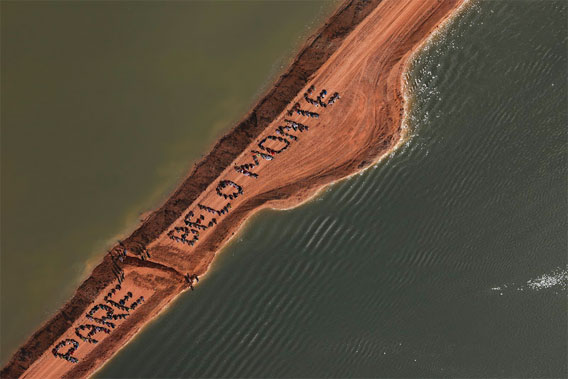
There’s an article over on Mongabay about a protest of the  Belo Monte Dam project in Brazil:
 Belo Monte will flood more than 40,000 hectares of rainforest and displace tens of thousands of people. The project will impede the flow of the Xingu, which is one of the Amazon’s mightiest tributaries, disrupting fish migrations and potentially affecting nutrient flows in a section of the basin.
Photo credit: Atossa Soltani/ Amazon Watch / Spectral Q
They will of course lose in the end like all native people have always lost. You will be hard pressed to find a more environmentally destructive power source yet here we have a very upbeat article titled Hot dam: Hydropower continues to grow  on an environmental website:
Brazil, the second-largest producer of hydropower worldwide, gets 86 percent of its electricity from water resources. It is home to an estimated 450 dams, including the Itaipu Dam, which generates more electricity than any other hydropower facility in the world — over 92 billion kilowatt-hours per year.
The article also mentions Grand Coulee dam and the fact that the United States gets about seven percent of its electricity from hydro. It didn’t mention that:
 Kettle Falls, once a primary Native American fishing grounds, was inundated. The average catch went from a historical average of over 600,000 salmon a year to nothing. In one study, the Army Corps of Engineers estimated the annual loss was over a million fish. The environmental impact of the dam effectively ended the traditional way of life of the native inhabitants. The government eventually compensated the Colville Indians in the 1990s with a lump settlement of approximately $52 million, plus annual payments of approximately $15 million.
Interestingly enough, the above link also says:
 In 2007, Grand Coulee generated the second-most energy among US power facilities, after the Palo Verde Nuclear Power Plant at 26.78 TWh. Palo Verde has a lower nameplate capacity but operates at a higher capacity factor, giving it slightly more annual output.
Which got me to thinking. There are over 1400 hydroelectric power plants in the U.S. compared to 105 nuclear power plants. The 105 nuclear power plants produce almost three times more energy …without destroying a single ecosystem or native culture. I then read a little bit about the Palo Verde Nuclear Power Plant:
Due to its location in the Arizona desert, Palo Verde is the only nuclear generating facility in the world that is not located adjacent to a large body of above-ground water. The facility evaporates water from the treated sewage of several nearby municipalities to meet its cooling needs. 20billion US gallons (76,000,000m³) of treated water are evaporated each year. This water represents about 25% of the annual overdraft of the Arizona Department of Water Resources Phoenix Active Management Area. At the nuclear plant site, the wastewater is further treated and stored in an 80 acre (324,000 m²) reservoir for use in the plant’s cooling towers.
You will be hard pressed to find an more environmentally friendly power source.

(Photo credit theslowlane via the Flickr Creative Commons license)