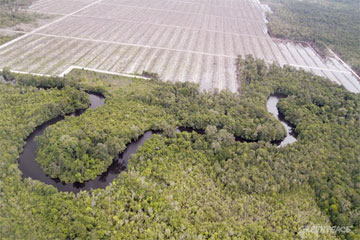
Hardi Baktiantoro
Does it matter? What do biofuels have to do with oil sands? This is called a logical fallacy. Specifically it is a
false dilemma in which only two alternatives are assumed (biofuels or oil sands), when in reality the options are not mutually exclusive, related, or even dependent on one another.
I borrowed this title from a post by John Guerrerio over on
Examiner.com.
When
several scientific studies began publishing reports that supported the common sense contention that food-based biofuels usurp farmland the Renewable Fuels Association (which just spent
almost a quarter of a million dollars last quarter on lobbying) had to cobble together some kind of defense.
Bob Dinneen, head of the RFA, has been using the Huffington Post blog to disseminate this false dilemma, see
here and
here.
I'd debate John on the Examiner blog in the comments but they only allow a thousand
words characters and no active links to verify claims. So I have to take him to task here.
In some ways biofuels are worse, and in some ways they are not, depending on what metric you are measuring and what biofuel you are talking about. For example, tar sands do not have nearly the impact on food prices, biodiversity, or the Rhode Island sized Gulf of Mexico Dead zone as corn ethanol, but corn ethanol produces less GHG than oil from tar sand (although not less than conventional gasoline depending on type of land displaced, nitrous oxide released from fertilizers, and time given to displace fossil fuels).
In addition, "biofuels" can be gaseous, liquid, or solid. They can come from landfill gas, used restaurant grease, or our food supply. They can help drive the orangutan to extinction as is the case with palm oil, or capture a powerful green house gas as is the case with manure treatment methane digesters.
At some point, environmentalists are going to have to face some harsh realities. In addition to subsidizing and mandating the use of environmentally destructive corn ethanol our politicians have just permitted the construction of a pipeline to deliver oil made from Canadian tar sands. Jobs, pork barrel politics, and the illusion of energy independence will always trump environmental issues.
The market funds Canadian oil to satiate consumer demand while corn ethanol is kept out of bankruptcy via subsidization by taxpayers who are then forced to consume it via government fiat. It does not matter which is worse in the aggregate. Both ideas are worse than just using regular sources of petroleum and certainly worse than investing in the replacement of our conventional internal combustion engine car technology, which
wastes 80% of the fuel in a gas tank regardless of what it is made from.
Here is a study for example that measured several types of biofuels against their fossil fuel equivalent and found in most cases that biofuels were actually worse and this does not even include land displacement or higher than realized nitrous oxide releases from nitrogen fertilizers (
which can make corn ethanol up to 50% worse than gasoline).
Ironically,
in this post, John tells us about the latest finding from NOAA:
The report shows that nitrogen emissions from natural processes are basically static, while manmade emissions such as the nitrogen fertilization of agricultural soils and fossil-fuel combustion have been growing steadily…
Whoosh, right over his head.
And here's
a nice piece of contradiction where he begrudgingly concedes that:
While factorially ommissive [sic] in its considerations, the Nature Conservancy report's ulitmate [sic] finding, "Energy sprawl deserves to be one of the metrics by which energy production is assessed", is a good one that should enter into the debate on energy.
Factorially? The Nature Conservancy, as you might guess, is all about conservation. Conservationists (hunters and fishermen) are often "conservative." In a masterful piece of diplomacy, these researchers coined a new term for indirect land use change (a term the RFA and the likes of John here have been busily denigrating) called "energy sprawl." It's like an atheist calling herself a secular humanist in an attempt to dodge the negative connotation religionists have given to the word atheist. It’s a robust term because to denigrate it you have to defend sprawl.
In the above article John tells us that the Nature Conservancy is just as wrong as every other researcher that has findings not supportive of food based biofuels. Biofuel missionaries are prone to cherry pick their science.
I know this post is getting long but I have just barely scraped the surface. I begin the line by line parsing below:
The simplified argument against biofuels states that "cutting down forests to clear more land for growing biofuel crops could double greenhouse gas emissions over the next 30 years", according to Wilson School research scholar Timothy Searchinger.
The concept is simple to understand, not simplified. If you divert food into gas tanks, someone will make up the difference by putting more land under the plow.
Critics rush to judgement against biofuels saying that it is not intelligent to spend money in this way, but these sme critics remain silent when it comes to figuring the direct land use costs associated with increasing our oil supply with imports from the Canadian oil sands.
The dozens of recent peer reviewed studies have hardly rushed to judgment. Claiming that biofuel critics are not also critical of oil from tar sands is a strawman argument. The land displaced by tar sands is minuscule on a gallon per gallon basis compared to food based biofuels.
A recent report by WWF highlights some of the direct costs of Canada's dirty oil.
Unlike John, who feels compelled to refute the Nature Conservancy study in defense of food-based biofuels, I wouldn't want to refute the WWF study. But don't fall for this false dilemma. Oil sand has nothing to do with biofuels. In addition, here is what the
WWF said to Obama in 2008:
Reconsider corn-based ethanol and support the development of best-practice performance standards. The demand for biofuels has increased food prices and accelerated deforestation that releases as much CO2 as gets saved at the tailpipe. Biofuels have a role to play in our response to climate change, but the rush to produce them has been ill-considered. The administration should support the development of performance-based standards to ensure that biofuels are part of the solution, not the problem.
John continues ...
Using biofuels to power our vehicles reduces overall emissions.
Again, no. How badly a biofuel increases emissions depends on what kind it is, where it is grown, and how many decades or centuries it will be grown. This has been documented in several studies now. From Wikipedia:
"Ad nauseam" arguments are logical fallacies relying on the repetition of a single argument to the exclusion of all else. This tactic employs intentional obfuscation, in which other logic and rationality is intentionally ignored in favour of preconceived (and ultimately subjective) modes of reasoning and rationality.
He continues ...
For this reason, the debate over whether or not to commercially produce biofuels has shifted to include these indirect costs associated with chopping down forests or taking land out of conservation status to grow plants to turn into fuel that we hear about so much in the media. Have these anti-biofuel number crunchers seen the landscape of the Canadian oil sands development? Can biofuel production really destroy a forest worse than this or this or this?
"Anti-biofuel number crunchers?" I think he means authors of published peer reviewed science papers. He goes on to link to photos of tar sand mining, which is analogous to coal mining except you get a liquid fuel instead of a solid one.
"Destroy a forest worse?" A destroyed forest is destroyed. It is a step function, not a matter of degree. It is destroyed or it is not. And yes biofuel production really can destroy forests just as bad. But the real clincher is that most of the destruction done by biofuels is in tropical forests, which are far more biologically diverse and store far more carbon than high latitude northern forests. It takes decades to centuries to recapture the carbon released by a destroyed forest.

From
here:
"…The area of rainforest in the process of being deforested — razed but not yet cleared — surged in the Brazilian Amazon during 2008…"
"…24,932 square kilometers of Amazon forest was damaged between August 2007 and July 2008, an increase of 10,017 square kilometers -- 67 percent -- over the prior year. The figure is in addition to the 11,968 square kilometers of forest that were completely cleared, indicating that at least 36,900 square kilometers of forest were damaged or destroyed during the year
"…The surge in activity is attributed to the sharp rise in commodity prices over the past two years. While grain and meat prices have plunged since March, higher prices have provided an impetus for converting land for agriculture and pasture. Accordingly, the burning season of 2007 (July-September) saw record numbers of fires in some parts of the Amazon as farmers, speculators, and ranchers set vast areas ablaze to prepare for the 2008 growing season
"…U.S. consumption of corn to supply domestic ethanol production created a global corn frenzy which drove up prices and spurred expansion of croplands around the planet. Two examples are Brazil and Laos. Brazil increased production of soy to essentially make up for soy acreage lost to corn in America. In Laos (pictured), returns from corn were so high that Vietnamese traders pressured national park officials to open up protected areas in parts of the country to corn fields. They refused.
"…falling grain prices early in the year coincided with a sharp slowing in deforestation. As food and fuel prices peaked through late 2007 and early 2008, it appeared that Amazon deforestation would climb to levels not seen since 2005 — more than 15,000 square kilometers were expected to be lost. The sudden downturn changed all that. When the final numbers came in for 2008, they showed that deforestation only increased a modest 3.8% to 11,968 square kilometers…."
He continues ...
One square kilometer is roughly 247 acres, so the Canadian oil sands cover roughly 34.5 million acres.
That number represents the total area of tar sands in Canada, not what is actually being mined and according to Wikipedia, only ten percent of those reserves are concentrated enough to be economically mined. So, make that 3.5 million acres, or 5,400 square miles. You could drive a car at 60-mph around a circle that big in 4 hours. Our ethanol crop alone usurps about 30,000 square miles every year, never mind the impact of canola, soy, palm, and cane, and the area of land converted to biofuel crops grows every year along with government mandates for biofuel use.
Joule Technologies with their 20,000 gallons of biofuel per acre per year technology could make 691,600,000,000 gallons of biofuel on the very same spot in Canada that we have already clearcut for oil sands production.
What does this have to do with food-based biofuels? This is another case of bait and switch. Not that I wouldn't support a magical technology like that, but good God,
Joule Technologies is just another snake oil sales firm. How naïve can you get? The EPA was counting on Cello for most of our cellulosic fuel next year, a company just convicted of
fraud.
Why do biofuels get strapped with ILUCs until their production capabilities are so hindered with doubt that investors run for the hills, while oil sand development gets a free ride?
Note that John's argument oscillates between calling land use change a crock, and claiming oil sands are just as land intensive (land use change isn't a crock), one argument contradicting the other. The EPA looked into the land use issues associated with tar sand oil and found what I did. Gallon for gallon, and over all they are not anywhere near as land intensive as today's food-based biofuels. This is a false dilemma, don't fall for the bait and switch.
The simple fact of the matter is that biofuels will never be as dirty as the oil sands in Canada, both in terms of energy cost to extract it and environmental degradation from its recovery.
The term "dirty" is not well defined. This is a debate technique where you deliberately choose words that can mean just about anything. It is left to the imagination. And he is flat out wrong about the energy balance of corn ethanol being better than oil sands. Roughly 70% of the energy contained in a gallon of corn ethanol came from fossil fuels. His contention that the environmental degradation gallon for gallon of tar sands is worse than corn ethanol is also pure conjecture.
Note how he conflates the fact that tar sand oil is more carbon intensive than food-based biofuels with land displacement use issues. Don’t fall for it.
We ought to be placing the the same level of scrutiny upon our fossil fuel industry that we are placing on biofuels. Since 'experts' say biofuels cannot sustain our society, we dont't foster their development; the same experts say that oil can no longer sustain our society, and we throw billions of dollars at securing the resource for the future...no common sense.
The above comment is riddled with errors. For starters "we" do scrutinize fossil fuels. Our politicians ignore that scrutiny for personal gain, just as they are allowing continued subsidization and mandated use of corn ethanol.
It is a strawman to say that because biofuels can't sustain our society that we don't foster their development. The government is flushing billions down the toilet on corn ethanol and cellulosic. The government isn't throwing billions of dollars at Canadian oil, we consumers are. That is being driven by and paid for by the market, not by government handouts. I agree that our government should not allow the use of such a carbon intense fuel. The hard reality is that oil is fungible. If we don't buy it, someone else will.
Perhaps a closer look at today's biofuel technology will reveal that the ILUCs for biofuel are far lower than the direct costs associated with oil sands and OCS driling as well as mountaintop mining practices in Appalachia. We need to start looking at the costs of the alternatives to biofuels and comparing production them.
The above comment continues the attempt to connect tar sand oil to biofuels. There is no connection. Why would a serious researcher compare apples to oranges? Direct costs obviously favor tar sand oil over biofuels, which is why one has to be subsidized and use mandated and one does not. One is kept out of bankruptcy only by continued government largess and the other sustains a profit in the market. Biofuels disrupt food supplies, destroy vast carbon sinks and biodiversity. The tar sand oil creates more CO2 than conventional oil but usurps very little in the way of carbon sinks and biodiversity.
We are already getting oil from Canadian oil sands; biofuels definitely stack up cleaner than the oil sands process.
Here we go with the vague terms again. What exactly is the definition of "cleaner?" This is also pure conjecture, but even if future scientific studies prove biofuels "cleaner," there still is no connection between tar sand oil and biofuels.