Touch here for mobile friendly version

Showing posts with label climate change. Show all posts

Thursday, August 3, 2017

Greenpeace isn't the only one, the UCS, Sierra Club, FOE, and even the WWF, to name just a few, all share the blame.


Michael Shellenberger is going after Greenpeace in a series of articles exposing their disingenuous anti-nuclear energy activities. More power to him.
  • Climate change isn't a global conspiracy by scientists to solicit research funding.
  • Climate change is the result of mass global deforestation and the combustion of billions of tons of hydrocarbons that have been stored underground for hundreds of millions of years.
  • The oceans are not going to absorb the extra carbon and heat energy forever.
I could be wrong about climate change. You never know. But isn't it about time to stop using coal to make electricity, regardless? Coal was the replacement for wood when parts of Europe ran out of forests to burn. It's old-school, dangerous to mine, environmentally destructive (although less so that burning wood), and filthy. Nuclear has been coal's main competitor for over half-a-century now. It is a much cleaner and environmentally friendly alternative. Maybe we should replace coal plants with nuclear plants and lessen the impact on those who make a living mining coal by facilitating their participation in their construction and operation?

Should we risk trying to decarbonize without help from nuclear, risk the effects of climate change by excluding the world's largest source of proven, scalable, low carbon electricity? Considering that there is no meaningful risk to including nuclear in the energy mix and that the risk of excluding it may be cataclysmic, the answer should be one of those rare no-brainers.

Video of a dragonfly laying eggs

Nature was collapsing all around us long before anyone heard of climate change. Read the latest in a very long line of books about this subject: The Sixth Extinction: An Unnatural History. Just a few days ago I took the above video of a dragonfly laying eggs in a goldfish pond. This is not an intact ecosystem. It's covered with a net to keep the cats, raccoons, and herons from eating said colorful carp, which are an invasive species, as is the English ivy in the foreground. It has a pump to aerate the water, and the fish are fed fish food made from fish. Being in the middle of a city you can hear the city noises; cars, trucks, aircraft, snippets of conversations. If the larvae of that dragonfly reduce the goldfish population, that's fine, because dragonflies also eat mosquitoes.

Argentine wildlife reserve--Esteros del Ibera

Speaking of which, I once had the pleasure of visiting an increasingly rare, largely intact ecosystem. You have probably never experienced one this intact, and as sad as this sounds, your children and grandchildren are even less likely to do so. While watching caiman, capybara, and any number of other fascinating creatures go about their business at dusk, I witnessed hundreds of thousands of dragonflies rising into the sky to eat mosquitoes (3:17 into above video and pardon the poor quality for I knew not what I was doing). Although it was ideal mosquito habitat, I don't recall being bitten by one, or even seeing one, while there.

What led many of the world's largest environmental organizations to focus on nuclear energy at the expense of nature (nuclear is one of our most benign sources of energy when it comes to ecosystem disruption--Chernobyl actually resulted in the creation of Europe's largest wildlife preserve)?

Monday, July 4, 2016

Our future is in low carbon energy, not just green (whatever that means) energy


Columbia Nuclear Generating Station in Washington State
 Cross-posted to Energy Trends Insider.

Robert McCullough has an Op-Ed in the Seattle Times titled "Our future is in green energy not aging, costly nuclear plants" that rebuts an earlier Op-Ed by James Moss supporting Washington State's single nuclear power station. McCullough:

"I read James Moss’ recent Op-Ed with interest and some amusement. The interest reflects whether Washington’s aging and very expensive nuclear plant is a good use for our energy dollars. Moss is doing a good job for his union constituents and takes a position I normally support. Sadly, we may not be on the same side regarding the costs."

I read Robert McCullogh's Op-Ed above with interest and some amusement.


Which got me to wondering who these Northwest clients might be? Neither the Times article nor the study he references says. But based on the Wikipedia article about this power station, I'm pretty sure I know who it is:

In December 2013, Robert McCullough, ... published an analysis of the economics of Columbia Generating Station commissioned by Physicians for Social Responsibility, a group that advocates eliminating the use of nuclear power.

Shouldn't the Times have divulged that information so readers would know he was being paid by a well-known antinuclear energy group? And don't let the group's name (Physicians for Social Responsibility), which is an argument from authority, fool you. It would be a big mistake to ask a physician to fix your brakes. I'm married to a physician. I know a lot of physicians. Physicians don't know any more about nuclear energy than any other lay person ...maybe less.

His antinuclear bias is further exposed by his repetition of old, dog-eared, antinuclear talking points. Below I will show you where he isn't being completely accurate with us using my tried and true (and mostly arbitrary) veracity score system with a rating of ten defined as a cold hard fact all the way down to one, which can be defined in any number of colorful ways.

Friday, June 24, 2016

Did Climate Change Drive the Bramble Cay Melomys to Extinction? Probably


Bramble Cay melomys (Melomys rubicola)
Credit Ian Bell/Queensland Department of Environment and Heritage Protection


 Melomys Rubicola has been declared extinct. Had it been something like a fuzzy koala or panda instead of a rat, the world might have taken more notice, but maybe not. A Google search on the topic goes over 20 pages deep. This seems to have struck a nerve.

It's possible that an undiscovered genetically identical population exists somewhere else. It's not unheard of for a species declared extinct to show up again. But if it has been on that tiny island off the coast of Papua New Guinea long enough for speciation to occur, then it is extinct because to repopulate someplace else a pregnant female would have needed to leave the island and establish itself elsewhere, and that is extremely unlikely.

There have been some dubious claims of extinctions caused by climate change, as one would expect, and I'm sure there will be many more. But little by little, the real extinctions will arrive.
 
I poked around on the internet for critiques of this announcement and found three, two of which were not worth bothering with (one confused the ozone problem with climate change) so I settled on the one at Energy Matters, which is an excellent blog and on my regular reading list. The analysis provided on this particular topic is characteristically thorough but not thorough enough to convince me.

Roger Andrews found that there has not been an increase in the number or intensity of cyclones in that area since 1969. He also looked up the tide gauge records for the area since 2000 and created a crude best fit line through it to determine that the ocean level in that part of the world may have only risen maybe 2.5 inches since 2000. His conclusion was that because the highest point on this island is about nine feet (even with the seasonal fifteen inch increase in sea level rise during cyclone season) sea level rise since 2000 would not have made much difference. And according to the authors' explanation, he's right. Temperature changes are likely the main driver, not sea level rise.

So there you have it. The demise of Melomys rubicola had nothing to do with temperature, rainfall or sea level rise. The animal was a victim of storm surges that progressively destroyed its habitat.

This is where Andrew lost me. The researchers are the ones who stated that Melomys rubicola was the victim of repeated storm surges over the last decade that progressively destroyed its habitat. Given time, this is how it will end for other island species.

No evidence – not even a climate model – is presented to support the claim that these storm surges had anything to do with increasing atmospheric CO2.

But the report does present evidence. Keeping in mind that CO2 levels not seen for 800,000 years have led to warmer temperatures which have in turn led to rates of ocean level increase not seen in millennia (all three of which are measured, not modeled) and contrary to the tidal and cyclone data presented by Andrew, the repeated storm surges at that island over the last decade were obviously severe enough to eventually wipe them out after having been there for at least 1.7 centuries.

Tuesday, May 24, 2016

Andrew Revkin on Making Veracity Cool


 (Photo credit: patries71 via Flickr)

Andrew Revkin posted an interesting article a few weeks back:

Lately, I’ve come to frame the challenge as a question: Can we foster an online (and real-life) culture in which veracity is cool? You’ll see more on this here in the coming months.

As social primates, we are instinctively motivated to seek higher status in our given troop hierarchies. The word cool is sometimes used as a synonym for impressive. Impressive denotes a measure of status. Coolness is any marketer's primary weapon. I like Andy's idea of making veracity cool, but I'm skeptical it could ever take hold. How would car marketers ever convince us to buy their cars? Although, certainly, he's on the right track in that, if you want to change behavior, like getting people to drive electric cars (or Hummers), convincing them it's cool to drive one will work wonders. 

What I think we need is to teach critical thinking skills in our schools as part of every math and science course, from grade school through college, and test for competency like we do for math and science.

His post led me to Climate Feedback, a website designed to fact check climate change articles. I was struck by how similar the format was to the Disqus comment software where you can use a little hypertext markup language to highlight quotes from an article and then discuss it in detail with links to sources, photos, graphs etc. They also made use of a veracity score which I have half-seriously used a few times myself, here and here.

The first question that came to mind was why the scientists didn't simply post in the comment field under the article? I suggested as much in a comment under Andy's article and interestingly enough, at least to me, my comment never made it past the Dot Earth moderator. So, maybe that was the answer to my question.

Monday, October 25, 2010

Birth Control will not stop climate change


...but it sure could help. From a study recently published in the Proceedings of the National Academy of Sciences

...reducing peak population to roughly 8 billion, for example, could save 29 percent of expected greenhouse gas emissions.


In addition, if people are allowed to retire at a reasonable age (there is a trend to increase retirement ages), some industrialized countries could also see a very large drop in CO2 emissions.

On the negative side, increasing urbanization could increase emissions because that trend tends to go along with greater wealth and wealthier people tend to do stupid things like build large homes, drive large cars, and buy second homes.


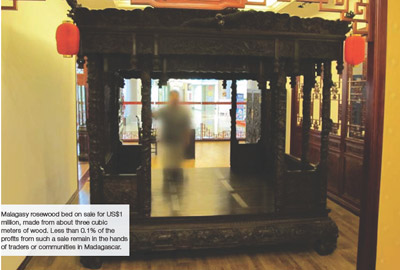
The $1 million dollar bed pictured above came from this Mongabay article:

The report, based on more than a year of investigations, shows that Madagascar's valuable hardwoods—including ebony, pallisander, and rosewood—are being illegally harvested from rainforest parks and trafficked to Asia, Europe, and the United States. The vast majority of timber—98 percent—however ends up in China, where it is converted into luxury furniture.

"In China, Malagasy rosewood beds sell for a million dollars apiece...

The person who buys the above bed should get the prestigious "Moron of the Century" award. It's not just how many of us are consuming but how and what we are consuming as well.

I suspect that if a global meme were to get started that super-efficient, solar enhanced, small homes, and cars were cooler than the cavernous status symbols of today, urbanization and the wealth that follows could drive emissions down more than the study estimates.

Click here--to see a list of articles and to subscribe to future posts or subscribe by email:

Enter your email address:

Delivered by FeedBurner

Thursday, April 1, 2010

Climate Debate Apogee


Foil hat image from Wikipedia Commons.

Climate Gate was inevitable. For a while there the lay press and television news was rife with headlines about various and sundry climate science "hoaxes." I dutifully chased down one claim after the other, which all turned out to be hoax hoaxes. Luckily there are a few blogs out there that serve as liaisons to climate scientists, conveying explanations to the general public. Most researchers are not real interested in engaging the ignorant masses (and who can blame them). They just want to do their research.

Climate Gate reinforced my opinion that climate change is real. Nothing more convincing than watching three or four front page hoax claims go down in flames in quick succession. You would think that a line of debunked claims stretching past the horizon would dampen a skeptic's enthusiasm but then again, the majority of Americans don't buy the theory of evolution.

Climate Gate had the opposite impact on many people, reinforcing their suspicion that climate change is a hoax. The difference being that some sought out and read science-based sources to get the real scoop and others stuck with what they last saw in their local newspaper, or most likely, television news. Television is the backbone of ongoing adult education in America. Read "Entertaining Ourselves to Death" then rent the movie Idiocracy ; )

The game is over. Public interest is rapidly waning. Most have made up their minds. Not that it matters. It is unlikely that our government is capable of solving the problem--not real sure they should try. There is a very real chance they would only make things worse as witnessed with corn ethanol. Hopefully, solutions will arrive "despite" government, as sometimes happens. It is possible that a green energy meme has been set in motion as happened with family size in the past. Time will tell.

If we are to replace fossil fuels with something better, it will happen for reasons unforeseen at this time. The future is notoriously hard to predict. I once thought that personal computers in homes were a fad that would eventually give way to cheap word processors (which was actually starting to happen) and machines dedicated to computer games (which is happening). Then the Internet came along.

There are still quite a few sputtering armchair climatologists out there (a subspecies of Internet Baboon) participating in the skeptic echo chamber. One great explanation I've seen for their existence (on top of my contention that people are capable of and willing to believe anything they want) involves an aspect of the Dunning-Kruger effect. I'm not sure how seriously to take parts of this study. The authors were the recipients of the prestigious Ig Nobel prize (get it, ignoble?). The Dunning-Kruger studies are sometimes used (wrongly) to beat debate opponents about the head and shoulders with the claim they are too stupid to know how stupid they are.

It isn't about stupidity (whatever that is). It is about ignorance. We can be too ignorant to know just how ignorant we are. You see this a lot in comment fields.

I read the book Superorganism by Bert Hölldobler and E.O. Wilson. It must weigh five pounds and represents the tip of an iceberg. Who would have dreamed that there is so much to know about ...ants. Imagine the equivalent of today's armchair climatologists engaging Wilson in debate on the subject of sociobiology, or ants for that matter.

I recall the time I used the Great Wall of China as an example of government waste in an article only to be called on the carpet by a scholar who studies great walls around the world (and apparently there are many such walls). In another article about rhino poaching I attracted a specialist in rhinos with similar results.

I also recall a beer commercial where the engineer put the finishing touch on the business jet he just designed (closing the radome). Miller time! The person who wrote that commercial had no idea what it takes to design a jet, or a radome for that matter ; ).

[Update 4/12/2010: A short, relatively respectful debate ensued in the comment field from which I drew a few more insights. What motivates the armchair climatologist? Some apparently see themselves as purveyors of truth and justice, struggling against the "establishment." This suggests to me that whatever it is that motivates the stereotypical conspiracy theorist is also at work here in the climate skeptic blogs.

In this case my nemesis used the bacterial-ulcer link and continental drift as examples where the established science was overturned by armchair versions of geologists and medical researchers. I love analogies but a bad analogy is worse than no analogy. For starters, my debate partner got it ass-backwards. The new science is climate change. The old guard is saying that there is no anthropomorphic climate change. He's defending what was once thought to be true.

The continental drift theory had been kicked around for centuries and was not particularly controversial. A concerted attempt to debunk it was made by a physicist as late as 1953 and his arguments would have looked very sound to armchair plate-techtonisists. I'm sure he would have had a large following had the internet existed.

The bacterial link to ulcers was discovered by researchers using the scientific method and peer reviewed publications.

All new theories, evolution, relativity, you name it, are met with resistance by other scientists The scientific method works because it meshes with human nature. Scientists love to prove their competitors wrong, which can also be an easy ticket to fame and glory. Finding flaws in a theory or hypothesis is much easier than forming a new one.

Monday, January 18, 2010

How I Reduced My Natural Gas Use 75 Percent for Less Than $1,400


(Photo credit VA5LF via the Flickr Creative Commons license).

[Update 5/04/2010] We had a record warm winter this year so I could not tell what the impact of the new furnace was. However, I just got a gas bill for a month where the average temperature was just one degree warmer than last year and my gas bill was considerably higher. Not cool. It is possible to use more gas with a 95% efficient furnace than an old 80% one. My guess is that the more powerful blower has been pressurizing my leaky ducts and forcing a lot of hot air out into my unheated basement. Sure enough, when I inspected the new duct installed on top of the new furnace I found a 1/4 inch wide by 2 foot long gap in the back. That leak alone is almost like having an extra furnace register to nowhere! I am now in the process of sealing all joints and will let you know what happens.


[Update 4/11/2010] A 2 inch diameter plastic plug fell out of the furnace today allowing the exhaust to dump strait into my basement. The technicians forgot to apply any PVC glue to it. This is a situation that could very easily be fatal to a sleeping family.

This is an update to a post I did last winter titled:

Weatherization Nation--How I reduced my natural gas use 60 percent for less than $400

In that post I speculated that getting the next 20 percent reduction (for my goal of 80 percent total) was going to cost more than the first 60 percent, which was the result of picking all of the low hanging fruit (weatherizing). It has cost me an additional $1,000 to date to get that last 15 percent by replacing my worn out 80 percent efficient furnace with a 95 percent efficient one. The price difference between an 80 and a 95 percent furnace is about $1,000, which I added to $400 to come up with $1,400, which I admit is creative book keeping because my new furnace cost a lot more than a $1,000.

My hot water solar panels are on hold until better weather. I've concluded that a heat pump hot water tank would not be cost effective for my application. I found a study where this concept was tested in different cities. The test done in Seattle showed very little gain for two main reasons. The tank was in an unheated basement (as mine would be) and the winter air temperature was too low to provide much energy. In addition, the winter temperature of tap water in Seattle tends to be quite cold because it is coming from snow melt.

If one of these is located in, say, a hall closet, it will act just like an air conditioner, cooling your house to heat your water causing your furnace to use more energy to heat your house back up for a net energy loss.

Putting one in an attic would work because a lot of hot air ends up there that you can't use. On the other hand, a hot water heater in an attic is asking for real trouble when it eventually springs a leak.

In short, if you can't find a warm place outside of your home's insulated and heated envelope for one of these, they probably won't do much for you during the heating season.

One day it dawned on me that my 80 percent efficient gas furnace is 20 years old. This is old for any appliance, especially a gas furnace. This led me to discover that my gas utility is offering a $350 rebate to anyone upgrading to a 90 percent efficient furnace. And to ice the cake, the stimulus package offers a 30 percent tax credit, up to $1,500, for the entire cost of upgrading to a 95 percent efficient gas furnace. The rebate and credit knocked $1,400 off the $3,600 cost.

This credit is analogous to the cash for clunkers program for cars in that it will use a lot of tax money to accomplish next to nothing environmentally. It's mostly an excuse to pump money into the sagging economy, and only a fool turns down a government handout.

One drawback to government meddling like this is that businesses tend to jack prices to capitalize on the credits, nullifying some of the benefits to the consumer to grab some for themselves. This happened to the Prius when the hybrid credit went into effect. Every contractor was trying to use the rebate and credit to make their bids appear lower. I asked them not to mention either in their bids so I could get a clear apples to apples price comparison.

With sales tax, I will end up paying $2,500 for a 77,000 BTU Lennox furnace with a variable speed motor and two stage burner.

This furnace should in theory account for another 15 percent decrease in gas use, thus my estimate of a 75 percent reduction from our normal gas bills. That makes me only 5 percent away from my 80 percent goal.

I chose this furnace design for two main reasons. The variable speed motor uses half the power of my old furnace (when on low), saving about 300 watt-hours for every hour it runs (on low). This will help with my efforts to reduce electricity use 80 percent, which I have not yet written about.

I wanted a two stage burner because my home's heating needs are modest by today's McMansion standards and the furnace should run most of the time with the blower at lower speeds and with only half of the burners ignited. The higher blower speeds and extra burners will come in handy on especially cold days but will for the most part remain on standby.

Let me share some things I learned so you don't have to climb up the same learning curve.

To achieve this kind of efficiency, today's higher end, 95 percent furnaces have reached ridiculous levels of complexity. All things being equal, complexity equates to higher cost and lower reliability in general. For this reason I registered with Lennox for their extended warranty, which is free at this time as a promotion, which is another reason I chose Lennox ...although more than one salesman told me that most of the major parts inside most furnaces are made by the same companies.

Thermostats have also reached ridiculous levels of complexity, especially if you have central air and heat combined, which I don't, thank God. There is little need for cooling in Seattle. Today's higher end thermostats communicate with the programmable circuit board in the furnace to do all kinds of worthless things, much like the never ending new and improved versions of Microsoft Word.

I refused to be talked into a fancy thermostat. I liked my bullet proof, but not very accurate, round mercury switch version that is about half a century old. I didn't want the technicians to even touch it. They touched it anyway and I'll get to that part in a minute.

The last thing you want is to wait for your furnace to fail in the middle of winter when you can't take the time to get multiple bids and are at the mercy of the sharks.

January is a good time of year to get bids from contractors because business tends to be a little slack, in part because nobody is in the mood to spend money after seeing their Christmas Visa bills, especially in this economy. I got seven bids and coincidentally chose the one right smack in the middle of the price ranges.

I threw out two of lowest bids because (after checking on the Internet) the model numbers listed were not for a variable speed two-stage furnace, as I requested.

The next lowest bid was only $170 less than what I accepted but was for a furnace that I was not sure would really qualify for the tax credit. The website claimed it was "up to" 95 percent efficient. The tax form says "at least" 95 percent efficient. Some companies have compromised on the efficiency percentage points to keep the price a little lower than competitors. They got caught by the hard and fast cutoff of 95 percent by the federal tax credit and have been scrambling to modify their furnaces so they can pass independent tests certifying that their furnaces are 95 percent efficient. The furnace contractor certainly would not be liable if the furnace ends up not qualifying a year after installation, so just because he says it will qualify does not mean it will.

The three bids that were higher were significantly higher, up to $1,500 higher for the same furnace I had installed.

The lowest bids were done by the business owners themselves. The higher bids were, not surprisingly, done by salesmen working on commission.

Green being the latest shtick, two of the highest bidders, although from different companies, arrived in Priuses with the words "hybrid heating and cooling" painted on their sides. One was a 2010 model with a solar panel built into the roof. Thanks to the Prius, the word "hybrid" has a lot of marketing appeal. I drive one myself, when my wife isn't using it ...

One salesman confided that they had tried to market solar panels but gave them up after several bad outcomes.

Another whipped out a laptop with a printer and started to do an energy audit of my house in order to pick the appropriate sized furnace. I told him not to bother because it would be meaningless in a home that incorporates night insulation window plugs, and passive solar heat gain. We also close the heating vents to the upstairs. In addition, I suggested that a two stage furnace may stay on the lower settings most of the time making the whole analysis of dubious value. Not to mention, the furnace sizes come in a few large increments so you are likely to be slightly over-sized or under-sized no matter what you do. I buried them with common sense and now I just have to hope I didn't screw myself somehow.

This salesman said I would have to sign a paper that I would not sue if the heating system is sized wrong. I called his bluff, didn't sign a paper, and they didn't get the job (this was the highest bid with the guy driving the 2010 Prius).

My new furnace arrived on a Monday morning, 1.5 hours after it was supposed to. The first thing I did was check the part number to make sure they were not going to try to install a similar but cheaper model. The only difference in the model part numbers was the letter "V" which stood for variable speed motor and the furnace laying in my garage floor did not have a "V" in the part number. I pointed this out to the technician (who was late because he had gotten lost) so he called his boss who insisted that this was the right furnace, even though the part number on the bid clearly had a "V" in it. He finally capitulated and said he would send another one out.

This was supposed to be a simple swap out. All they had to do was replace a short piece of ducting to transition from the new furnace, rearrange the gas pipe, and install the PVC exhaust ducts, all in a wide-open unfinished basement.

They kept trying to talk me into a new thermostat, I suspect because they had managed to break the thermostat wire off in the wall. They could not get a new wire up to my thermostat because of blocking in the wall. The technician had to remove my old thermostat and I had a feeling it would never be the same again. I finally got a hammer and chisel and cut a notch in my sheet rock around the blocking and dropped a chain to the poor technician who was at his wits end by now.

After all this they could not get the furnace to work because it had a bad inductor motor and we had to spend the night without heat.

After they left I inspected their work. The technicians had twisted and cocked the existing gas pipes rather than install proper lengths of pipe, giving the installation a Dr. Seuss look, with one pipe sitting on a switch that could not now be turned. The new duct didn't fit and had two one-inch wide gaps that they covered in tape. I could see that the furnace was not level from ten feet away and they ran the condensate line down my siding rather than into my mop sink as requested. Oh,and the filter was leaning up against the furnace at about a 30 degree angle with no way to secure it to the duct opening.

I called the boss and complained. The next morning I was not pleased to see a very pissed off technician at my door who informed me that he was there to rearrange the gas pipes "on his own time," that the furnace was supposed to lean in that direction, and one inch gaps were perfectly acceptable. I'm just hoping he did not run a screwdriver though the circuit board before he left, but at least the furnace now works.

I decided to replace my thermostat after all this because, oddly enough, it was no longer working properly. I wanted a simple, non-programmable unit and as usual turned to the internet for advice. I found one commenter who, after taking the advice of another commenter on how to hook up his thermostat, found that it had melted over night. Later I found the comment that had misled him on another thread. I wonder how many houses that jackass has burned down.

I also learned that you have to take what the contractors tell you with a big grain of salt. Trust but verify. They just want to sell you a furnace. It's a jungle out there. Good luck!

Click here--to see a list of articles and to subscribe to future posts or subscribe by email by adding your address to the box in the upper right hand corner of the blog.